The influence of the addition of granulated sugar on the organoleptic quality of dendeng ground meet deer (Cervus timorensis)
DOI:
https://doi.org/10.46549/jipvet.v15i4.611Keywords:
Ground deer‑meat dendeng (DGDR), Sucrose, Hedonic test, Repeated‑measures, Friedman test, Overall acceptability, SMEsAbstract
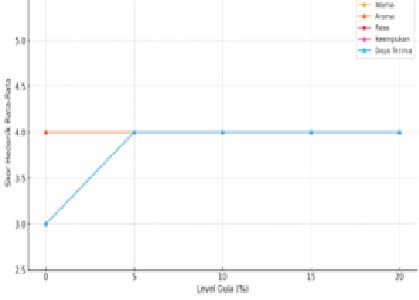
This study evaluated sucrose at concentrations of 0, 5, 10, 15, and 20% (w/w) in ground deer meat dendeng (DGDR) to inform SME-oriented formulation. The products were dried at 60°C for 24 hours. They were then assessed by 30 semi-trained panelists (1–5 hedonic) in a within-panelist repeated-measures design. Ordinal data were analyzed using a Friedman omnibus test with Holm-adjusted Wilcoxon signed-rank comparisons. Results are reported as medians. The color increased significantly at ≥10% compared to 0%. Taste improved with sugar, producing a smoother sweet–spice balance. Aroma remained characteristic across levels. Tenderness showed a non‑significant softening at ≥15%. Overall acceptability increased with sugar, with 10–20% exceeding the control (p < 0.05). Five percent showed a trend upward, indicating an early plateau at 5% or higher. Sucrose thus functions as a practical lever to elevate appearance and liking without compromising aroma under the specified process. A formulation of 12–15% is recommended as the default. Levels of 15–20% suit markets seeking darker colors and slightly sweeter profiles. Future work should pair hedonic outcomes with instrumental measurements of color, texture, and volatility. It should also include shelf-life studies and evaluate clean-label preservation options or partial sucrose substitution.
Downloads
Publication Integrity
WALABI applies editorial screening and peer review in accordance with its journal policies.
- Similarity screening reference: 20% (evaluated in context)
- Ethical approval disclosure is required where applicable
- Generative AI / AI-assisted technology disclosure is required where applicable
- Author contributions are expected
- Conflict of interest disclosure is expected
References
Cropp MS, Tarté R, Prusa KJ, Dickson JS, Shaw AM, Houser TA, Crowley RI, Reever LM, Sebranek JG. 2023. Impact of nitrite-embedded packaging film on quality and sensory attributes of alternatively-cured and nitrite-free bologna. Meat Science. 204;109289. https://doi.org/10.1016/j.meatsci.2023.109289
Gamba M, Filho T, Lúcia S, Vidigal M, Simiqueli A, Minim V. 2020. Performance of different scales in the hedonic threshold methodology. Journal of Sensory Studies. 35(5). https://doi.org/10.1111/joss.12592
Grispoldi L, Karama M, El Ashram S, Saraiva C, García Díez J, Chalias A, Cenci Goga B. 2022. A study on the application of natural extracts as alternatives to sodium nitrite in processed meat. Journal of Food Processing and Preservation. 46(3). https://doi.org/10.1111/jfpp.16351
Jang SJ, Kim HW, Hwang KE, Song DH, Kim YJ, Ham YK, Lim YB, Jeong TJ, Kim SY, Kim CJ. 2015. Effects of replacing sucrose with various sugar alcohols on quality properties of semi dried jerky. Korean Journal for Food Science of Animal Resources. 35(5):622 629. https://doi.org/10.5851/kosfa.2015.35.5.622
Karwowska M, Kononiuk A. 2020. Nitrates/nitrites in food—Risk for nitrosative stress and benefits. Antioxidants. 9(3):241. https://doi.org/10.3390/antiox9030241
Kaur R, Kaur L, Gupta T, Singh J, Bronlund J. 2022. Multitarget preservation technologies for chemical free sustainable meat processing. Journal of Food Science. 87(10):4312 4328. https://doi.org/10.1111/1750-3841.16329
Kim D, Shin D, Lee J, Kim Y, Han S. 2022. Effect of different brine injection levels on the drying characteristics and physicochemical properties of beef jerky. Food Science of Animal Resources. 42(1):98 110. https://doi.org/10.5851/kosfa.2021.e66
Kim S, Kim T, Kim H, Jung S, Yong H, Choi Y. 2021. Quality characteristics of semi dried restructured jerky processed using super heated steam. Foods. 10(4):762. https://doi.org/10.3390/foods10040762
Nam K, Kim H, Cha J, Yim D. 2016. The quality characteristics and antioxidant properties of sun dried venison jerky with green tea powder during storage. Korean Journal for Food Science of Animal Resources. 36(5):626 634. https://doi.org/10.5851/kosfa.2016.36.5.626
Panitsa A, Petsi T, Kandylis P, Nigam P, Kanellaki M, Κουτίνας A. 2021. Chemical preservative delivery in meat using edible vegetable tubular cellulose. LWT. 141;111049. https://doi.org/10.1016/j.lwt.2021.111049
Randa SY, Tirajoh S, Sjofjan O. 2021. Teknologi produksi abon daging rusa dengan penambahan herbal sebagai pangan unggulan pada era normal baru. Jurnal Ilmu Peternakan dan Veteriner Tropis (JIPVET). 11(3). https://doi.org/10.46549/jipvet.v11i3.174
Serrano MP, Maggiolino A, Landete Castillejos T, Pateiro M, Barbería JP, Fierro Y, Domínguez R, Gallego L, García A, De Palo P, Lorenzo JM. 2020. Quality of main types of hunted red deer meat obtained in Spain compared to farmed venison from New Zealand. Scientific Reports. 10;12222. https://doi.org/10.1038/s41598-020-69071-2
Shakil M, Trisha AT, Rahman M, Talukdar S, Rovina K, Huda N, Zzaman W. 2022. Nitrites in cured meats, health risk issues, alternatives to nitrites: A review. Foods. 11(21):3355. https://doi.org/10.3390/foods11213355
Sípos L, Nyitrai Á, Hitka G, Friedrich L, Kókai Z. 2021. Sensory panel performance evaluation—Comprehensive review of practical approaches. Applied Sciences. 11(24):11977. https://doi.org/10.3390/app112411977
Sipahelut GM, Armadianto H, Noach YR, Riwu AR, Dillak SYF, Rede Lae Riwu J. 2021. Level pemberian tepung rosella (Hibiscus sabdariffa Linn) terhadap kualitas dendeng babi. Jurnal Ilmu Peternakan dan Veteriner Tropis (JIPVET). 11(2). https://doi.org/10.46549/jipvet.v11i2.148
Suryati T, Arief I. 2020. Kualitas mikrobiologi dan fisikokimia dendeng sapi yang ditambahkan simplisia serbuk jahe merah. Jurnal Ilmu Ternak Universitas Padjadjaran. 20(1):1. https://doi.org/10.24198/jit.v20i1.26598
Thun Y, Yan S, Tan C, Teoh W, Gan X. 2022. Aroma taste texture cross modal interactions for sugar reduction in yoghurt drink. Nutrition & Food Science. 53(1):162 177. https://doi.org/10.1108/nfs-02-2022-0051
Toldrá F. 2014. Handbook of Fermented Meat and Poultry (2nd ed.). Wiley Blackwell.
Vanacore A, Pellegrino M. 2018. Checking quality of sensory data via an agreement based approach. Quality & Quantity. 53(5):2545 2556. https://doi.org/10.1007/s11135-018-0807-5
Wiklund E, Farouk M, Finstad G. 2014. Venison: Meat from red deer (Cervus elaphus) and reindeer (Rangifer tarandus tarandus). Animal Frontiers. 4(4):55 61. https://doi.org/10.2527/af.2014-0032
Yang J, Lee J. 2018. Korean consumers’ acceptability of commercial food products and usage of the 9 point hedonic scale. Journal of Sensory Studies. 33(6). https://doi.org/10.1111/joss.12467
Yong H, Kim T, Choi H, Jang H, Jung S, Choi Y. 2021. Clean label meat technology: Pre converted nitrite as a natural curing. Food Science of Animal Resources. 41(2):173 184. https://doi.org/10.5851/kosfa.2020.e96
Downloads
Published
How to Cite
Issue
Section
License
Copyright (c) 2025 Daniel Y. Seseray, Oktovianus Jandit, Hanike Monim, Hieronymus Y. Chrysostomus, John S. Randa, Iriani Sumpe, Frandz R. Pawere, Onesimus Yoku, Seblum Indey

This work is licensed under a Creative Commons Attribution-NonCommercial-ShareAlike 4.0 International License.
License and Copyright Agreement
In submitting the manuscript to the journal, the authors certify that:
- They are authorized by their co-authors to enter into these arrangements.
- The work described has not been formally published before, except in the form of an abstract or as part of a published lecture, review, thesis, or overlay journal. Please also carefully read Jurnal Ilmu Peternakan dan Veteriner Tropis (Journal of Tropical Animal and Veterinary Science) Posting Your Article Policy at https://journal.fapetunipa.ac.id/index.php/JIPVET/publicationethics
- That it is not under consideration for publication elsewhere,
- The publication has been approved by all authors and by the responsible authorities, tacitly or explicitly, of the institutions where the work was carried out.
- They secure the right to reproduce any material that has already been published or copyrighted elsewhere.
- They agree to the following license and copyright agreement.
Copyright
Authors who publish with Jurnal Ilmu Peternakan dan Veteriner Tropis (Journal of Tropical Animal and Veterinary Science) agree to the following terms:
- Authors retain copyright and grant the journal right of first publication with the work simultaneously licensed under a Creative Commons Attribution License (CC BY-NC-SA 4.0) that allows others to share the work with an acknowledgment of the work's authorship and initial publication in this journal.
- Authors are able to enter into separate, additional contractual arrangements for the non-exclusive distribution of the journal's published version of the work (e.g., post it to an institutional repository or publish it in a book), with an acknowledgment of its initial publication in this journal.
- Authors are permitted and encouraged to post their work online (e.g., in institutional repositories or on their website) prior to and during the submission process, as it can lead to productive exchanges, as well as earlier and greater citation of published work.

This work is licensed under a Creative Commons Attribution-NonCommercial-ShareAlike 4.0 International License.















.png)
