Rancang Bangun Sistem Tiga Strata dalam Sistem Pertanian Terintegrasi sebagai Penyedia Pakan Ternak Lokal Potensial di Lahan Bekas Tambang
Design and development of a three-strata system within an integrated farming system for providing potential local livestock feed on post-mining land
DOI:
https://doi.org/10.46549/igkojei.v7i4.694Keywords:
Hijauan pakan ternak, Lahan pascatambang, Pertanian terintegrasi, Restorasi agroekologi, Sistem tiga strata, Agroecological restoration, Integrated agriculture, Livestock feed greens, Post-mining land, Three-strata systemAbstract
ABSTRAK
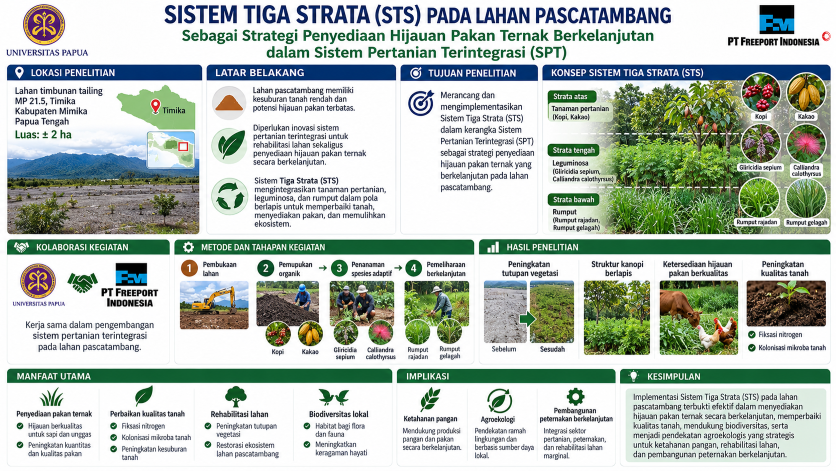
Penelitian ini bertujuan untuk merancang dan mengimplementasikan Sistem Tiga Strata (STS) dalam kerangka Sistem Pertanian Terintegrasi (SPT) sebagai strategi penyediaan hijauan pakan ternak (HPT) berkelanjutan pada lahan pascatambang. STS menggabungkan rumput, leguminosa, dan tanaman pertanian dalam pola berlapis yang berfungsi untuk meningkatkan kualitas dan kuantitas pakan, memperbaiki kesuburan tanah, serta menunjang restorasi ekosistem. Kegiatan dilakukan di lahan timbunan tailing seluas ± 2 ha di MP 21.5, Timika, melalui kerja sama antara Universitas Papua dan PT Freeport Indonesia. Intervensi agronomis meliputi pembukaan lahan, pemupukan organik, penanaman spesies adaptif: Kopi (Coffea canephora), Kakao (Theobroma cacao), gamal (Gliricidia sepium), Kaliandra (Calliandra calothyrsus), rumput raja (Pennisetum purphoroiedes) dan rumput gelagah (Saccharum spontaneum), serta pemeliharaan berkelanjutan. Hasil menunjukkan peningkatan tutupan vegetasi, struktur kanopi berlapis, dan ketersediaan hijauan berkualitas untuk ternak sapi dan unggas. Selain menghasilkan pakan, sistem ini turut meningkatkan kualitas tanah melalui fiksasi nitrogen dan kolonisasi mikroba tanah, serta mendukung biodiversitas lokal. Implementasi STS di lahan marginal terbukti menjadi pendekatan agroekologis yang efektif dalam mendukung ketahanan pangan, rehabilitasi lahan, dan pembangunan peternakan berkelanjutan.
Kata kunci: Hijauan pakan ternak; Lahan pascatambang; Pertanian terintegrasi; Restorasi agroekologi; Sistem tiga strata
ABSTRACT
This research aims to design and implement a Three-Strata System (TSS) within the framework of an Integrated Farming System (IFS) as a strategy for providing sustainable livestock forage (SLF) on post-mining land. STS combines grasses, legumes, and agricultural plants in a layered pattern that functions to improve the quality and quantity of feed, enhance soil fertility, and support ecosystem restoration. The activities were carried out on a ± 2 ha tailings storage area at MP 21.5, Timika, thru a collaboration between the University of Papua and PT Freeport Indonesia. Agronomic interventions include land clearing, organic fertilization, planting adaptive species Coffea canephora, Theobroma cacao, Gliricidia sepium, Calliandra calothyrsus, Pennisetum purphoroiedes dan Saccharum spontaneum, as well as sustainable maintenance. The results show an increase in vegetation cover, layered canopy structure, and the availability of quality forage for cattle and poultry. In addition to producing fodder, this system also improves soil quality thru nitrogen fixation and soil microbial colonization, as well as supporting local biodiversity. The implementation of STS on marginal lands has proven to be an effective agroecological approach in supporting food security, land rehabilitation, and sustainable livestock development.
Keywords: Agroecological restoration; Integrated agriculture; Livestock feed; greens; Post-mining land; Three-strata system
Downloads
References
Angelita TK, Rasyid B, Neswati R. 2020. Perbaikan kualitas tanah purna tambang nikel dengan penggunaan mikoriza dan biochar tandan kosong kelapa sawit. Jurnal Ecosolum. 9(1); 28–45.
Clay M, Nicolson L, Dunlop J, Purtill J. 2024. A review of research and tools for grazing as a post-mining land use in Queensland: Technical paper. Office of the Queensland Mine Rehabilitation Commissioner, Brisbane. 3.
Dile YT, Karlberg L, Daggupati P, Srinivasan R, Wiberg D, Rockström J. 2016. Assessing the implications of water harvesting intensification on upstream–downstream ecosystem services: A case study in the Lake Tana basin. Science of the Total Environment. 542; 22–35. https://doi.org/10.1016/j.scitotenv.2015.10.065
Donnison C, Holland RA, Harris ZM, Eigenbrod F, Taylor G. 2021. Land-use change from food to energy: Meta-analysis unravels effects of bioenergy on biodiversity and cultural ecosystem services. Environmental Research Letters. 16(11); 113005. https://doi.org/10.1088/1748-9326/ac22be
Kebede G, Assefa G, Feyissa F, Mengistu A. 2016. Forage legumes in crop-livestock mixed farming systems: A review. International Journal of Livestock Research. 6(4); 1–18. https://doi.org/10.5455/ijlr.20160317124049
Maharani R, Susilo A, Fernandes A. 2010. Bab 2 pembenah tanah pada lahan bekas tambang batubara. Reklamasi Bekas Tambang Batubara.
Masebo N, Birhane E, Takele S, Lucena JJ, Araceli P-S, Yunta F, Anjulo A. 2025. Microbial biomass carbon distribution under agroforestry practices and soil depth variations in Southern Ethiopia. Agroforestry Systems. 99(3); 1–15. https://doi.org/10.1007/s10457-025-01133-8
Pazla R, Zain M, Marta Y, Sucitra MP. 2023. Leguminosa sebagai pakan ternak ruminansia. Penerbit Adab, Indramayu.
Pratiwi, Narendra BH, Siregar CA, Turjaman M, Hidayat A, Rachmat HH, Maharani R. 2021. Managing and reforesting degraded post-mining landscape in Indonesia: A review. Land. 10(6); 658. https://doi.org/10.3390/land10060658
Rahman MHU, Ahrends HE, Raza A, Gaiser T. 2023. Current approaches for modeling ecosystem services and biodiversity in agroforestry systems: Challenges and ways forward. Frontiers in Forests and Global Change. 5; 1032442. https://doi.org/10.3389/ffgc.2022.1032442
Shakoor A, Dar AA, Arif MS, Farooq TH, Yasmeen T, Shahzad SM, Ashraf M. 2022. Do soil conservation practices exceed their relevance as a countermeasure to greenhouse gases emissions and increase crop productivity in agriculture? Science of the Total Environment. 805; 150337. https://doi.org/10.1016/j.scitotenv.2021.150337
Suherman D, Herdiawan I. 2015. Tanaman legum pohon Desmodium rensonii sebagai tanaman pakan ternak bermutu. Pastura. 4(2); 100–104.
Yaebiyo G, Tadsesse T, Birhane E, Hadgu KM, Kiros S, Meresa TM. 2024. Integrated adoption of controlled grazing and multipurpose fodder trees for enhancing tree cover in dryland farming systems. Agricultural Systems. 218; 103967. https://doi.org/10.1016/j.agsy.2024.103967
Downloads
Published
How to Cite
Issue
Section
License
Copyright (c) 2026 Freddy Pattiselanno, Onesimus Yoku, Evi W. Saragih, Djonly Woran, Daniel Y. Seseray, Willybrodus Amareyao, Feberius Harefa, Fersi K.I. Sing

This work is licensed under a Creative Commons Attribution-NonCommercial-ShareAlike 4.0 International License.
License and Copyright Agreement
In submitting the manuscript to the journal, the authors certify that:
- They are authorized by their co-authors to enter into these arrangements.
- The work described has not been formally published before, except in the form of an abstract or as part of a published lecture, review, thesis, or overlay journal. Please also carefully read IGKOJEI: Jurnal Pengabdian Masyarakat Posting Your Article Policy at https://journal.fapetunipa.ac.id/index.php/igkojei/policy/publicationethics
- That it is not under consideration for publication elsewhere,
- That its publication has been approved by all the author(s) and by the responsible authorities – tacitly or explicitly – of the institutes where the work has been carried out.
- They secure the right to reproduce any material that has already been published or copyrighted elsewhere.
- They agree to the following license and copyright agreement.
Copyright
Authors who publish withIGKOJEI: Jurnal Pengabdian Masyarakat agree to the following terms:
- Authors retain copyright and grant the journal right of first publication with the work simultaneously licensed under a Creative Commons Attribution License (CC BY-NC-SA 4.0) that allows others to share the work with an acknowledgment of the work's authorship and initial publication in this journal.
- Authors are able to enter into separate, additional contractual arrangements for the non-exclusive distribution of the journal's published version of the work (e.g., post it to an institutional repository or publish it in a book), with an acknowledgment of its initial publication in this journal.
- Authors are permitted and encouraged to post their work online (e.g., in institutional repositories or on their website) prior to and during the submission process, as it can lead to productive exchanges, as well as earlier and greater citation of published work.

This work is licensed under a Creative Commons Attribution-NonCommercial-ShareAlike 4.0 International License.