Physical and protein characteristics of rabbit meat fed multinutrient hay waffles
DOI:
https://doi.org/10.46549/jipvet.v16i2.616Keywords:
Rabbit meat, hay multinutrient waffle, meat characteristics, Hycole breedsAbstract
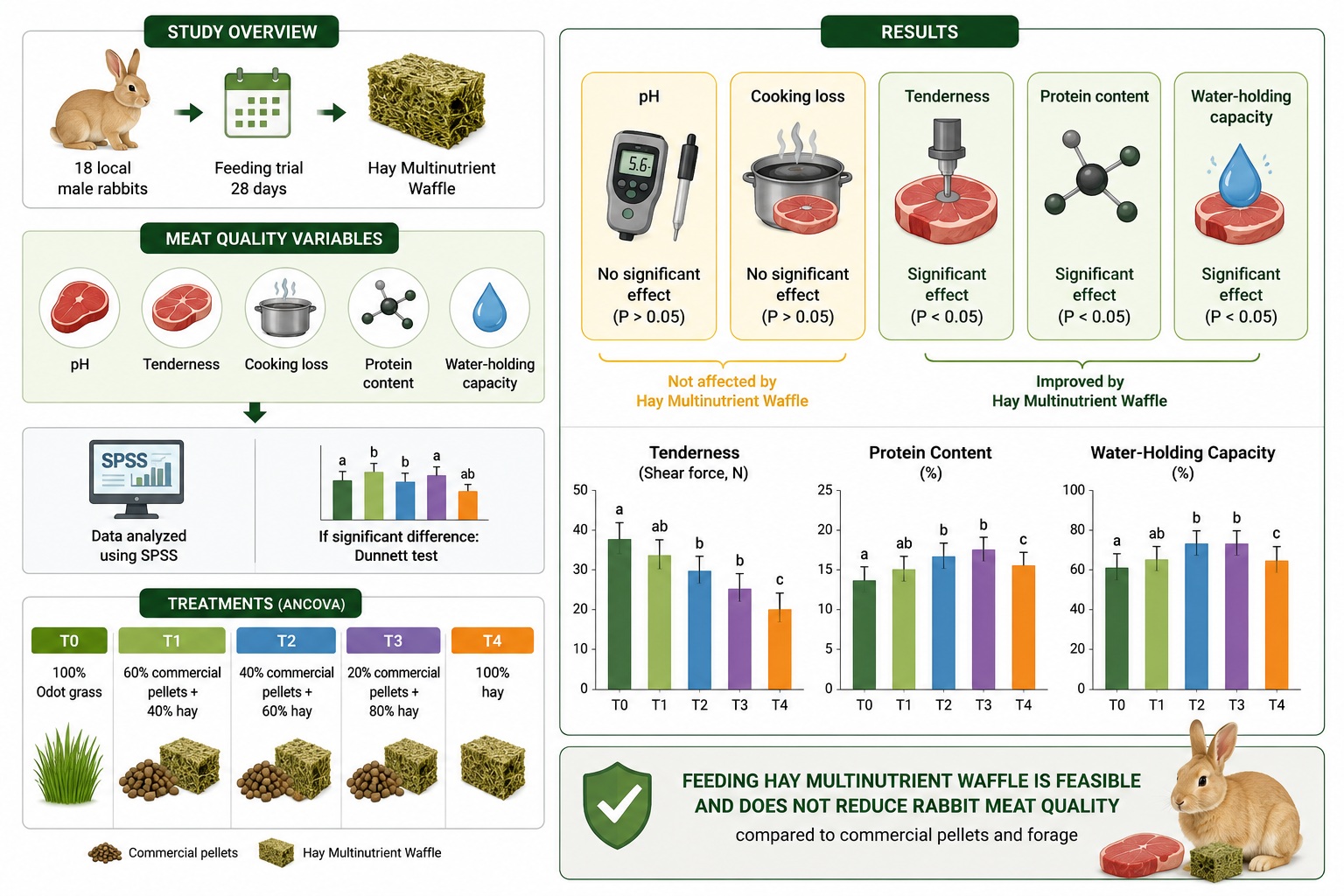
The quality of the meat generated as a byproduct of rabbit fattening is related to the feed quality. The physical qualities of meat are one of the feed-related elements that customers evaluate when purchasing meat. Colour, tenderness, pH, water retention capacity, and cooking loss are all important markers of meat quality. The goal of this study was to look at the physical characteristics of rabbit meat given hay-based multinutrient waffles. During a two-month feeding trial, 18 female Hycole rabbits were separated. The characteristics studied included pH, softness, cooking loss, protein content, and water holding capacity. Data were examined using SPSS, and if significant differences were found, the Dunnett test was used to do additional analysis. The findings revealed that feeding hay-based multinutrient waffles had no significant effect on pH or cooking loss, but had a substantial impact on softness, protein content, and WHC. since a result, using hay-based multinutrient waffles in rabbit diets may be regarded economically viable, since it maintains meat quality comparable to commercial pellets and forage.
Downloads
References
Abd. Rahman As-syakur, Suarna IW, Rusna IW, Dibia IN. 2011. Pemetaan kesesuaian iklim tanaman pakan serta kerentanannya terhadap perubahan iklim dengan sistem informasi geografi (SIG) di Provinsi Bali. Pastura. 1(1); 9–15.
Shanks BC, Wulf DM, Maddock RJ. 2002. Technical note: The effect of freezing on Warner-Bratzler shear force values of beef longissimus steaks across several postmortem aging periods. Journal of Animal Science. 80(8); 2122–2125. https://doi.org/10.2527/2002.8082122x
Brahmantiyo B, Setiawan MA, Yamin DM. 2014. Sifat fisik dan kimia daging kelinci Rex dan lokal (Oryctolagus cuniculus). Jurnal Peternakan Indonesia. 16(1); 1–7. https://doi.org/10.25077/jpi.16.1.1-7.2014
Dal Bosco A, Castellini C, Mancini S, Bosa L, Di Federico F, Nompleggio L, Huja S, Mattioli S. 2025. Alfalfa and linseed oil in diet for fattening rabbits: Performance, meat quality, and nutritional characteristics. Animals. 15(23). https://doi.org/10.3390/ani15233409
Darmayanti R, Rianto E, Purbowati E. 2013. Pengaruh kualitas pakan terhadap keempukkan daging pada kambing kacang jantan. Animal Agriculture Journal. 2(4).
Hatmiko S. 2014. Pengaruh Pakan Fermentasi Menggunakan Bakteri Azotobachter terhadap pH, Daya Mengikat Air, dan Susut Masak Daging Kelinci. Skripsi. Universitas Brawijaya, Malang.
Huff-Lonergan E, Lonergan SM. 2005. Mechanisms of water-holding capacity of meat: The role of postmortem biochemical and structural changes. Meat Science. 71(1); 194–204. https://doi.org/10.1016/j.meatsci.2005.04.022
Kurniawan YM. 2013. Komposisi Karkas dan Sifat Fisik Daging Kelinci Lokal Jantan Muda dengan Pemberian Pakan Mengandung Limbah Tauge. Skripsi. Fakultas Peternakan, Institut Pertanian Bogor, Bogor.
Lawrie RA. 2003. Ilmu Daging. Terjemahan Aminuddin Parakkasi. Penerbit Universitas Indonesia, Jakarta.
Masanto R, Agus A. 2013. Kelinci Potong: Pembibitan dan Penggemukan. Penebar Swadaya, Jakarta.
Prayitno S, Sumarmono J, Hantoro DRA. 2020. Pengaruh lama perendaman daging itik afkir pada ekstrak kulit buah carica (Carica candamarcensis) terhadap keempukkan dan susut masak daging. https://doi.org/10.30997/jpnu.v6i1.1815
Ricardo LGY, Hartati CDS, Suwarta F. 2025. Pengaruh Azolla microphylla dalam ransum terhadap kualitas fisik daging kelinci. Journal of Animal Production Technology. 2(1).
Setiawan MA. 2009. Karakteristik Karkas, Sifat Fisik dan Kimia Daging Rex dan Lokal. Skripsi. Fakultas Peternakan, Institut Pertanian Bogor, Bogor.
Soeparno. 2005. Ilmu dan Teknologi Daging. Gadjah Mada University Press, Yogyakarta.
Timur NPVT, Syaefullah BL, Labatar SC, Bachtiar EE. 2023. Cattle disease studies via geographical information system in Bowi Subur Village, Masni District, Manokwari Regency, West Papua Province. Jurnal Ilmu-Ilmu Peternakan. 33(1); 109–115. https://doi.org/10.21776/ub.jiip.2023.033.01.013
Downloads
Published
How to Cite
Issue
Section
License
Copyright (c) 2026 Gallusia Marhaeny Nur Isty

This work is licensed under a Creative Commons Attribution-NonCommercial-ShareAlike 4.0 International License.
License and Copyright Agreement
In submitting the manuscript to the journal, the authors certify that:
- They are authorized by their co-authors to enter into these arrangements.
- The work described has not been formally published before, except in the form of an abstract or as part of a published lecture, review, thesis, or overlay journal. Please also carefully read Jurnal Ilmu Peternakan dan Veteriner Tropis (Journal of Tropical Animal and Veterinary Science) Posting Your Article Policy at https://journal.fapetunipa.ac.id/index.php/JIPVET/publicationethics
- That it is not under consideration for publication elsewhere,
- The publication has been approved by all authors and by the responsible authorities, tacitly or explicitly, of the institutions where the work was carried out.
- They secure the right to reproduce any material that has already been published or copyrighted elsewhere.
- They agree to the following license and copyright agreement.
Copyright
Authors who publish with Jurnal Ilmu Peternakan dan Veteriner Tropis (Journal of Tropical Animal and Veterinary Science) agree to the following terms:
- Authors retain copyright and grant the journal right of first publication with the work simultaneously licensed under a Creative Commons Attribution License (CC BY-NC-SA 4.0) that allows others to share the work with an acknowledgment of the work's authorship and initial publication in this journal.
- Authors are able to enter into separate, additional contractual arrangements for the non-exclusive distribution of the journal's published version of the work (e.g., post it to an institutional repository or publish it in a book), with an acknowledgment of its initial publication in this journal.
- Authors are permitted and encouraged to post their work online (e.g., in institutional repositories or on their website) prior to and during the submission process, as it can lead to productive exchanges, as well as earlier and greater citation of published work.

This work is licensed under a Creative Commons Attribution-NonCommercial-ShareAlike 4.0 International License.















.png)
