Pembuatan dedak padi fermentasi dan penggunaannya pada pakan ayam kampung
Fermented Rice Bran Making and Its Use in Native Chicken Feed
DOI:
https://doi.org/10.46549/igkojei.v7i3.706Keywords:
Dedak padi, Fermentasi, Nira lontar, Pakan ayam kampung, UMKM ElshaddayAbstract
ABSTRACT
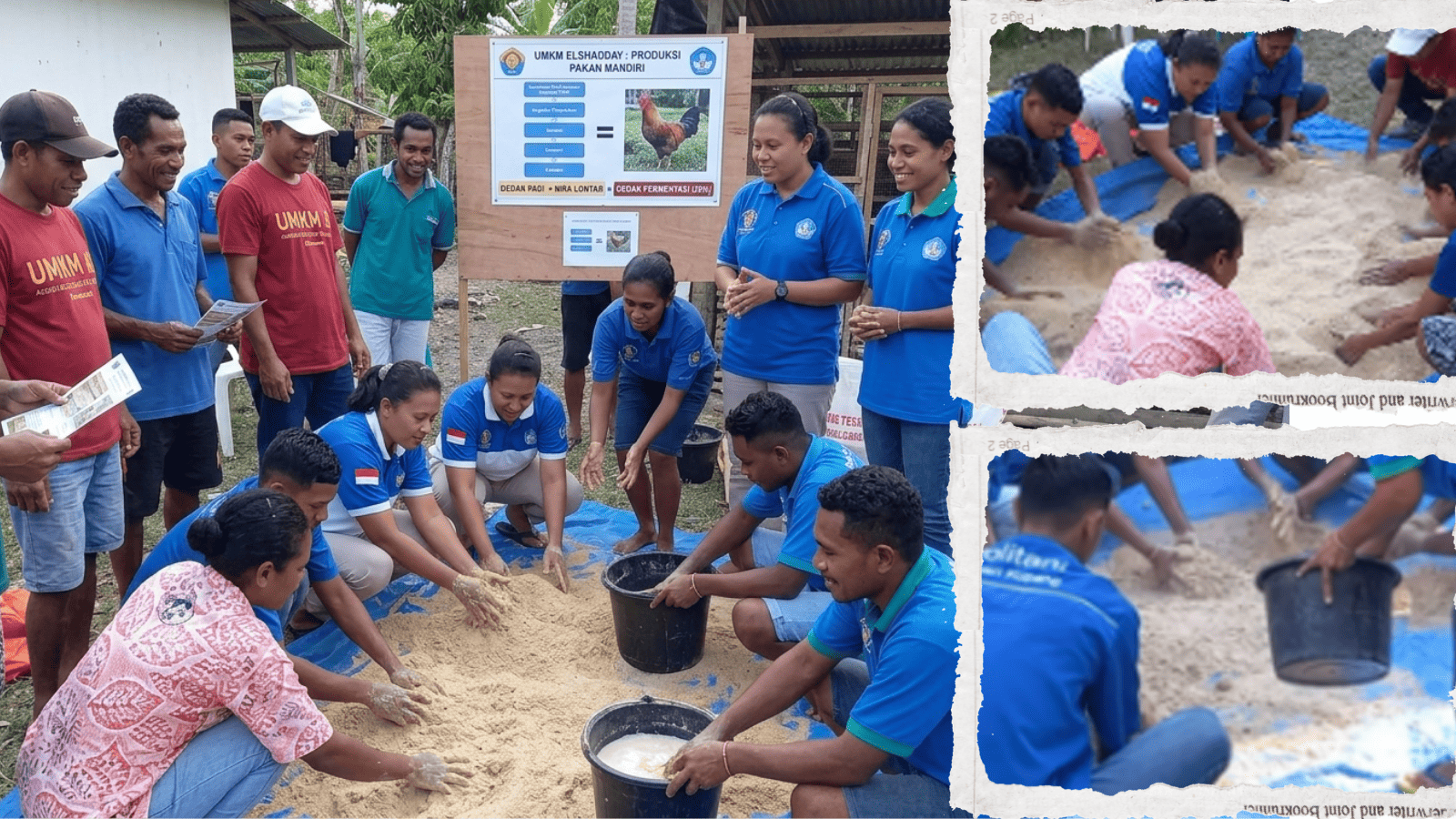
Kampoeng chickens are widely raised across Indonesia and represent an important source of animal protein and household income in rural communities. Their productivity is closely associated with the quantity and quality of feed. Rice bran is an inexpensive and readily available feed ingredient; however, its inclusion in poultry diets is generally limited to approximately 10% because of its high crude fiber content (25–27%) and phytic acid concentration (7.39 mg/100 g), which reduce nutrient utilization. Previous research demonstrated that fermenting rice bran with palmyra sap effectively reduced crude fiber and phytic acid levels, thereby improving its nutritional value and allowing its inclusion to be increased to 20% in kampoeng chicken diets without compromising growth performance. These findings were disseminated through a community engagement program involving 15 members of the Elshadday UMKM, a kampoeng chicken farmer association located in Teun Baun Village, West Amarasi District, Kupang Regency. The program aimed to enhance farmers' knowledge and technical skills in producing fermented rice bran and utilizing it as a feed ingredient in kampoeng chicken rations. The activities consisted of educational counseling, group discussions, and on-farm demonstration plots. Participants received both theoretical instruction and hands-on training in the fermentation of rice bran using palmyra sap, feed formulation, and feed preparation. The program substantially improved farmers' knowledge, with understanding of rice bran fermentation increasing by 100% and knowledge of feed formulation and feed manufacturing increasing by 66.67%. By the end of the program, participants were able to formulate native chicken diets containing up to 20% palmyra sap-fermented rice bran. These results demonstrate that integrating research outcomes with community-based training is an effective approach to promoting the adoption of locally available feed technologies and improving the capacity of smallholder poultry farmers.
Keywords: Fermentation; Native chicken feed; Palmyra sap; Rice bran; UMKM Elshadday
ABSTRAK
Ayam kampung merupakan komoditas unggas lokal yang tersebar luas diberbagai wilayah di Indonesia. Produktivitas ayam kampung dipengaruhi oleh kuantitas dan kualitas pakan. Pakan ayam tersusun dari berbagai bahan pakan, seperti jagung dan dedak padi. Dedak padi diperoleh dengan harga yang murah dan digunakan 10% dalam pakan ayam. Terbatasnya penggunaan dedak padi karena kandungan serat kasar 25-27% dan kadar asam fitat 7,39 mg/100g. Proses fermentasi dedak padi dengan nira lontar terbukti efektif menurunkan kandungan serat kasar dan asam fitat. Peningkatan kualitas nutrisi tersebut memungkinkan dedak padi terfermentasi dimanfaatkan hingga taraf 20% dalam pakan ayam kampung tanpa menurunkan performa ternak. Hasil penelitian ini diimplementasikan kepada kelompok peternak mitra yang terdiri atas 15 anggota UMKM Elshadday yang bergerak dalam usaha pemeliharaan ayam kampung. Kelompok mitra tersebut berlokasi di Desa Teun Baun, Kecamatan Amarasi Barat, Kabupaten Kupang. Kegiatan pengabdian ini bertujuan untuk meningkatkan pengetahuan dan keterampilan peternak dalam mengolah dedak padi melalui teknologi fermentasi serta memanfaatkannya sebagai bahan baku penyusunan ransum ayam kampung. Metode yang digunakan dalam kegiatan pengabdian ini adalah penyuluhan, diskusi kelompok, dan demonstrasi plot (demplot). Selama program, para petani diberikan pengetahuan dan keterampilan praktis tentang pengolahan dedak padi melalui fermentasi menggunakan nira lontar dan pemanfaatan dedak padi fermentasi sebagai komponen pakan ayam kampung. Program ini secara efektif meningkatkan pengetahuan peserta, tentang fermentasi dedak padi menggunakan nira lontar meningkat sebesar 100% dan pengetahuan tentang formulasi pakan dan pembuatan pakan meningkat sebesar 66,67%. Peternak dapat membuat pakan ternak ayam kampung dengan menggunakan dedak padi hasil fermentasi dengan nira lontar sebesar 20% dalam pakan.
Kata kunci: Dedak padi; Fermentasi; Nira lontar; Pakan ayam kampung; UMKM Elshadday
Downloads
References
Ali N, Agustina and Dahniar. 2019. Pemberian Dedak yang Difermentasi dengan EM4 sebagai Pakan Ayam Broiler. Agrovital : Jurnal Ilmu Pertanian. 4(1): 1–4. https://doi.org/10.35329/agrovital.v4i1.298.
Arisudhana D, Laksmiwati M, Priyanto S, Rahayu I and Qodariah. 2023. Penyuluhan Kalkulasi Harga Pokok Produksi Biaya Penuh untuk Penentuan Harga Jual UMKM di Desa Majau. Dinamisia : Jurnal Pengabdian Kepada Masyarakat. 7(2): 383–391. https://doi.org/10.31849/dinamisia.v7i2.13381.
Asminaya NS, Tasse AM, Sandiah N, Nuraini, Badaruddin R, Indi A, Napirah A, Hadini HA and Salido WL. 2021. Pengembangan Ternak Ayam Kampung melalui Penerapan Teknologi Inseminasi Buatan dan Pemanfaatan Pakan Lokal di Kota Kendari. IGKOJEI: Jurnal Pengabdian Masyarakat. 2(3): 99–105. https://doi.org/10.465 49/igkojei.v2i3.238.
Badan Standardisasi Nasional Indonesia. 2013. Pakan Ayam Buras-Bagian 1- Starter (SNI 7783.1:2013).
Chitra U, Singh U and Venkateswara RP. 1996. Phytic Acid, in Vitro Protein Digestibility, Dietary Fiber, and Minerals of Pulses as Influenced by Processing Methods. Plant Foods for Human Nutrition. 49(4): 307–316. https://doi.org/10.1007/BF01091980.
Das S and Tamang JP. 2021. Changes in Microbial Communities and Their Predictive Functionalities During Fermentation of Toddy, An Alcoholic Beverage of India. Microbiological Research. 248: 1–13. https://doi.org/10.1016/j.micres.2021.126769.
Debi MR, Wichert BA and Liesegang A. 2019. Method Development to Reduce the Fiber Content of Wheat Bran and Rice Bran through Anaerobic Fermentation with Rumen Liquor for Use in Poultry Feed. Asian-Australasian Journal of Animal Sciences. 32(3): 395–404. https://doi.org/10.5713/ajas.18.0446.
Ermalia AAU, Sjofjan O and Djunaidi IH. 2016. Evaluation Nutritients of Rice Bran Second Quality Fermented Using Rumen Fluid. Buletin of Animal Science. 40(2): 113–123. https://doi.org/10.21059/buletinpeternak.v40i2.
Hanisah, Nurjannah, Putri M. and Basriwijaya KM. 2023. Pakan Alternatif dengan Kayambang Fermentasi Sebagai Penurun Kadar Kolesterol dan Peningkat Kandungan Antioksidan Telur dan Daging Itik di Desa Batee Puteh, Langsa, Aceh. Dinamisia : Jurnal Pengabdian Kepada Masyarakat. 7(6): 1547–1556. https://doi.org/10.31849/dinamisia.v7i6.15925.
Hidayat RA and Isnawati I. 2021. IIsolasi dan Karakterisasi Jamur Selulolitik pada Fermetodege: Pakan Fermentasi Berbahan Campuran Eceng Gondok, Bekatul Padi, dan Tongkol Jagung. LenteraBio : Berkala Ilmiah Biologi. 10(2): 176–187. https://doi.org/10.26740/lenterabio.v10n2.p176-187.
Koni TN. I, Paga A, Aoetpah A, Vertygo S and Laisnesi M. 2024. Pembuatan Pakan Babi Fase Grower di Desa Bipolo Kecamatan Sulamu Kabupaten Kupang. IGKOJEI: Jurnal Pengabdian Masyarakat. 5(4): 161–167. https://doi.org/10.465 49/igkojei.v5i4.498.
Koni TNI, Foenay TAY and Jehemat A. 2022. Fermentation Characteristics and Chemical Composition of Fermented Rice Bran with Different Levels of Palmyra Sap (Borassus flabellifer). Livestock Research for Rural Development. 34(10): 88. Available at: https://www.lrrd.org/lrrd34/10/3488inda.html.
Koni TNI, Foenay TAY and Vertigo S. 2023. The Use of Urea and Palmyra Sap (Borassus flabellifer) on the Characteristics and Nutrient Composition of Fermented Rice Bran. Advances in Animal and Veterinary Sciences. 11(4): 624–629. https://doi.org/10.17582/journal.aavs/2023/11.4.624.629.
Koni TNI, Paga A and Asrul. 2024. Calcium, Phosphorus, and Phytic Acid of Fermented Rice Bran. in IOP Conference Series: Earth and Environmental Science. 1–4. https://doi.org/10.1088/1755-1315/1360/1/012010.
Koni TNI, Paga A, Jehemat A, Asrul, Batafor GG and Foenay TAY. 2025. Growth Performance of Java Super Chickens Fed Fermented Rice Bran During the Starter Phase. Journal of Animal Health and Production Growth. 13(1): 149–153. https://doi.org/10.17582/journal.jahp/2025/13.1.149.153.
Munira S, Nafiu LO and Tasse AM. 2016. Performans Ayam Kampung Super Pada Pakan yang Disubttusi Dedak Padi Fermentasi dengan Fermentor Berbeda. Jurnal Ilmu dan Teknologi Peternakan Tropis. 3(2): 21–29. https://doi.org/10.33772/jitro.v3i2.
Pratiwi I, Fathul F and Muhtarudin. 2015. Pengaruh Penambahan Berbagai Starter Pada Pembuatan Silase Ransum Terhadap Kadar Serat Kasar, Lemak Kasar, Kadar Air, Dan Bahan Ekstrak Tanpa Nitrogen Silase. Jurnal Ilmiah Pertenakan Terpadu. 3(3): 116–120. https://doi.org/10.23960/jipt.v3i3.p%p.
Randu MDS, Canadianti M, Yuliani NS, Anugrah DSR, Tabun AC, Wea R and Tulle DR. 2024. Introduksi Fermentasi Jerami Padi untuk Meningkatkan Produktivitas Ternak Sapi di Kelurahan Naioni, Kota Kupang. IGKOJEI: Jurnal Pengabdian Masyarakat. 5(1): 44–53. https://doi.org/10.46549/igkojei.v5i1.445.
Sapkota MM, Tiwari ICP, Gyawali N and Lamichhane U. 2021. Effect of Different Level of Wheat with and Without Phytase on Feed Intake, Growth Performance, Feed Efficiency and Economics in Cobb 500 Broilers. Sustainability in Food and Agriculture (SFNA). 2(1): 25–30. https://doi.org/10.26480/sfna.01.2021.
Surianti, Hasrianti, Damis, Gibran MH, Wahyudi and Mahfud C. 2024. Pengaruh Dedak Padi Terfermentasi Menggunakan Fermentor Berbeda dalam Pakan Ikan. Jurnal Galung Tropika. 13(3): 461–470. https://doi.org/10.31850/jgt.v13i13.1246.
Trisiwi HF. 2016. Pengaruh Level Protein Pakan yang Berbeda pada Masa Starter terhadap Penampilan Ayam Kampung Super. Jurnal Ilmiah Peternakan Terpadu. 4(3): 256–262. https://doi.org/10.23960/jipt.v4i3.p%25p.
Wahyuni S, Hindratiningrum N and Primandini Y. 2021. Pemanfaatan Pakan Lengkap Guna Menunjang Produktivitas Ternak Kambing. CARADDE: Jurnal Pengabdian Kepada Masyarakat. 4(1): 144–154. https://doi.org/10.31960/caradde.v4i1.895.
Wibawa AAP, Wirawan IW and Partama IBG. 2015. Peningkatan Nilai Nutrisi Dedak Padi sebagai Pakan Itik melalui Biofermentasi dengan Khamir. Majalah Ilmiah Peternakan. 18(1): 11–16.
Widayati O, Degey AB, Sudarmi N and Sadsoeitoeboen PD. 2023. Evaluasi Penyuluhan Pengaruh Pemberian Pakan Komersial terhadap Performa Babi Jantan Periode Starter di Kampung Sairo Distrik Manokwari Utara Kabupaten Manokwari. Journal of Sustainable Agriculture Extension. 1(2): 84–90. https://doi.org/10.47687/josae.v1i2.617.
Wijaya R, Budiman A and Mayasari N. 2024. Pengaruh Lama Fermentasi Pada penggunaan Dedak Fermentasi terhadap Kandungan Bahan Kering dan Bahan Organik Silase Tebon Jagung (Zea mays). Jurnal Sumber Daya Hewan. 5(2): 31–34. https://doi.org/10.24198/jsdh.v5i2.46533.
Downloads
Published
How to Cite
Issue
Section
License
Copyright (c) 2026 Theresia Nur Indah Koni, Agustinus Paga, Asrul, Melkianus D.S Randu, Tri A.Y. Foenay

This work is licensed under a Creative Commons Attribution-NonCommercial-ShareAlike 4.0 International License.
License and Copyright Agreement
In submitting the manuscript to the journal, the authors certify that:
- They are authorized by their co-authors to enter into these arrangements.
- The work described has not been formally published before, except in the form of an abstract or as part of a published lecture, review, thesis, or overlay journal. Please also carefully read IGKOJEI: Jurnal Pengabdian Masyarakat Posting Your Article Policy at https://journal.fapetunipa.ac.id/index.php/igkojei/policy/publicationethics
- That it is not under consideration for publication elsewhere,
- That its publication has been approved by all the author(s) and by the responsible authorities – tacitly or explicitly – of the institutes where the work has been carried out.
- They secure the right to reproduce any material that has already been published or copyrighted elsewhere.
- They agree to the following license and copyright agreement.
Copyright
Authors who publish withIGKOJEI: Jurnal Pengabdian Masyarakat agree to the following terms:
- Authors retain copyright and grant the journal right of first publication with the work simultaneously licensed under a Creative Commons Attribution License (CC BY-NC-SA 4.0) that allows others to share the work with an acknowledgment of the work's authorship and initial publication in this journal.
- Authors are able to enter into separate, additional contractual arrangements for the non-exclusive distribution of the journal's published version of the work (e.g., post it to an institutional repository or publish it in a book), with an acknowledgment of its initial publication in this journal.
- Authors are permitted and encouraged to post their work online (e.g., in institutional repositories or on their website) prior to and during the submission process, as it can lead to productive exchanges, as well as earlier and greater citation of published work.

This work is licensed under a Creative Commons Attribution-NonCommercial-ShareAlike 4.0 International License.