Pelatihan pengolahan pakan unggas organik berbasis limbah ikan pada KWT Citra Lestari, Kelurahan Sungai Besar, Kecamatan Banjarbaru Selatan, Kota Banjarbaru
Technical guidance on organic poultry feed processing based on fish waste in KWT Citra Lestari, Sungai Besar Village, South Banjarbaru District, Banjarbaru City
Keywords:
fish waste, fish meal, fish silage, organic poultry feed, women farmers group, limbah ikan, tepung ikan, silase ikan, pakan unggas organik, kelompok wanita taniAbstract
ABSTRACT
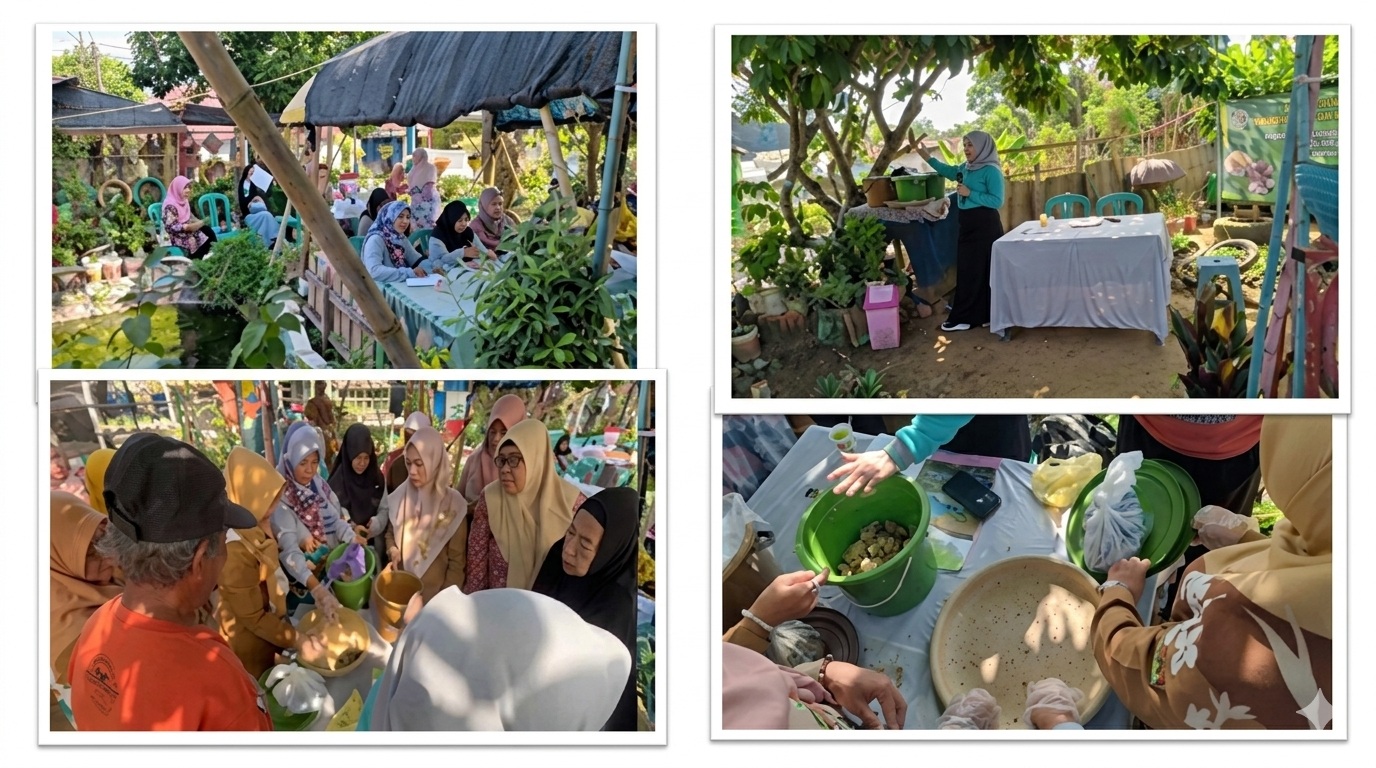
This community service programme aimed to empower the Citra Lestari Women Farmers Group in Sungai Besar, South Banjarbaru District, Banjarbaru City, through training on processing fish waste into organic poultry feed in the form of fish meal and fish silage. The activity was conducted in August 2025 and involved 20 participants from diverse occupational backgrounds, most of whom were small-scale livestock keepers. The programme employed a participatory approach consisting of initial interviews, theoretical training, demonstrations, and hands-on practice. Evaluation was carried out through pre-test and post-test, observation of participants’ practical skills, and proximate analysis of the products. The results showed that participants’ understanding of the training materials increased to the range of 75%–85%. Participants were generally able to identify suitable raw materials, understand the basic principles of fish waste processing, and produce fish meal and fish silage with acceptable physical qualities. The proximate analysis indicated that the fish meal contained 53.7% crude protein, while the fish silage contained 27.88% crude protein. About 50% of participants expressed willingness to continue applying the technology after the programme. These findings indicate that fish-waste-based feed processing training can strengthen community capacity, improve local resource utilisation, and support the development of alternative poultry feed at the community level.
Keywords: fish waste; fish meal; fish silage; organic poultry feed; women farmers group
ABSTRAK
Kegiatan pengabdian kepada masyarakat ini bertujuan untuk memberdayakan Kelompok Wanita Tani Citra Lestari di Kelurahan Sungai Besar, Kecamatan Banjarbaru Selatan, Kota Banjarbaru, melalui pelatihan pengolahan limbah ikan menjadi pakan unggas organik dalam bentuk tepung ikan dan silase ikan. Kegiatan dilaksanakan pada Agustus 2025 dengan melibatkan 20 peserta yang memiliki latar belakang profesi beragam, meskipun sebagian besar berprofesi sebagai peternak. Metode pelaksanaan menggunakan pendekatan partisipatif yang meliputi wawancara awal, pelatihan teoritis, demonstrasi, dan praktik langsung. Evaluasi dilakukan melalui pre-test dan post-test, observasi keterampilan peserta selama praktik, serta uji proksimat terhadap produk yang dihasilkan. Hasil kegiatan menunjukkan bahwa pemahaman peserta terhadap materi meningkat hingga berada pada kisaran 75%–85%. Peserta umumnya mampu mengenali bahan baku yang layak, memahami prinsip dasar pengolahan limbah ikan, serta menghasilkan tepung ikan dan silase ikan dengan mutu fisik yang baik. Hasil uji proksimat menunjukkan bahwa tepung ikan mengandung protein 53,7%, sedangkan silase ikan mengandung protein 27,88%. Sebanyak 50% peserta menyatakan keinginan untuk melanjutkan penerapan teknologi setelah kegiatan berakhir. Temuan ini menunjukkan bahwa pelatihan pengolahan limbah ikan dapat memperkuat kapasitas masyarakat, meningkatkan pemanfaatan sumber daya lokal, dan mendukung pengembangan pakan alternatif bagi unggas pada tingkat kelompok.
Kata kunci: limbah ikan; tepung ikan; silase ikan; pakan unggas organik; kelompok wanita tani
Downloads
References
Abun A, Rusmana D, Haetami K, Widjastuti T. 2025. Evaluation of the nutritional value of fermented pangasius fish waste and its potential as a poultry feed supplement. Veterinary World. 18(2); 355–366. https://doi.org/10.14202/vetworld.2025.355-366
Huwaidi N, Panggabean EL, Apriliya I. 2021. Peningkatan pengetahuan dan keterampilan pengolahan limbah ikan kepada kelompok nelayan tradisional secara daring di Belawan, Sumatera Utara. JPKMI: Jurnal Pengabdian Kepada Masyarakat Indonesia. 2(3); 191–201. https://doi.org/10.36596/jpkmi.v2i3.174
Kilmaskossu JP, Nebore IDY, Rumalolas N, Iwan, Sirait SHK, Erari SS, Tuririday HT, Yohanita AM, Wambrauw HL, Pramudita W, Luarwan JR, Manihuruk DLD, Resilay EM, Wanaha FG, Rumatan S, Sawor YS, Ayomi C, Kambu AY, Sangkek NT, Dewi NFK, Hanafi RIAA, Rimosan MFBR, Apriyani R, Tagi F, Wabia H. 2025. Edukasi pengolahan limbah kulit buah menjadi eco-enzim bagi masyarakat di Desa Petrus Kafiar. IGKOJEI: Jurnal Pengabdian Masyarakat. 6(2); 117–125. https://doi.org/10.46549/igkojei.v6i2.551
Libonatti CC, Agüería DA, Breccia J. 2023. Fish waste silage, a green process for low feedstock availability. A review. Agronomía Mesoamericana. 34(2); 51077. https://doi.org/10.15517/am.v34i2.51077
Martínez-Alvarez O, Chamorro S, Brenes A. 2015. Protein hydrolysates from animal processing by-products as a source of bioactive molecules with interest in animal feeding: A review. Food Research International. 73; 204–212. https://doi.org/10.1016/j.foodres.2015.04.005
Peñarubia OR, Toppe J, James D. 2020. Fish waste management: Turning waste into healthy feed with antimicrobial properties. Asian Fisheries Science. 33(S1); 11–15. https://doi.org/10.33997/j.afs.2020.33.S1.002
Ratiandi R, Imansyah F, Mooniarsih NT. 2020. Pengolahan limbah ikan menjadi produk bernilai ekonomis tinggi dengan sentuhan teknologi tepat guna mesin pembuat tepung ikan. Jurnal Pengabdi. 3(1); 51–64. https://doi.org/10.26418/jplp2km.v3i1.40742
Ravi SN, Elangovan V, Veeraragavan L, Packirisamy ASB, Sankaranarayanan M, Vaishnavi S. 2026. Fish-based waste as a source of future foods. Dalam Health, Nutrition and Sustainability. 547–562. https://doi.org/10.1016/B978-0-443-32920-3.00036-7
Rustad T, Storrø I, Slizyte R. 2011. Possibilities for the utilisation of marine by-products. International Journal of Food Science and Technology. 46(10); 2001–2014. https://doi.org/10.1111/j.1365-2621.2011.02736.x
Sahar RA, Fitrawati RAM, Arsyad MA, Umar K, Agus MNA, Ikram. 2024. Pemanfaatan limbah ikan menjadi pakan bernutrisi tinggi solusi inovatif dalam sektor perikanan di Kabupaten Kepulauan Selayar. Jurnal Ilmiah Wahana Laut Lestari. 2(1); 1–7. https://doi.org/10.33096/jiwall.v2i1.480
Shabani A, Boldaji F, Dastar B, Ghoorchi T, Zerehdaran S. 2018. Preparation of fish waste silage and its effect on the growth performance and meat quality of broiler chickens. Journal of the Science of Food and Agriculture. 98(11); 4097–4103. https://doi.org/10.1002/jsfa.8926
Sihite HH. 2013. Studi pemanfaatan limbah ikan dari tempat pelelangan ikan (TPI) dan pasar tradisional Nauli Sibolga menjadi tepung ikan sebagai bahan baku pakan ternak. Jurnal Teknologi Kimia Unimal. 2(2); 43–54.
Downloads
Published
How to Cite
Issue
Section
License
Copyright (c) 2026 Dharmawati Siti

This work is licensed under a Creative Commons Attribution-NonCommercial-ShareAlike 4.0 International License.
License and Copyright Agreement
In submitting the manuscript to the journal, the authors certify that:
- They are authorized by their co-authors to enter into these arrangements.
- The work described has not been formally published before, except in the form of an abstract or as part of a published lecture, review, thesis, or overlay journal. Please also carefully read IGKOJEI: Jurnal Pengabdian Masyarakat Posting Your Article Policy at https://journal.fapetunipa.ac.id/index.php/igkojei/policy/publicationethics
- That it is not under consideration for publication elsewhere,
- That its publication has been approved by all the author(s) and by the responsible authorities – tacitly or explicitly – of the institutes where the work has been carried out.
- They secure the right to reproduce any material that has already been published or copyrighted elsewhere.
- They agree to the following license and copyright agreement.
Copyright
Authors who publish withIGKOJEI: Jurnal Pengabdian Masyarakat agree to the following terms:
- Authors retain copyright and grant the journal right of first publication with the work simultaneously licensed under a Creative Commons Attribution License (CC BY-NC-SA 4.0) that allows others to share the work with an acknowledgment of the work's authorship and initial publication in this journal.
- Authors are able to enter into separate, additional contractual arrangements for the non-exclusive distribution of the journal's published version of the work (e.g., post it to an institutional repository or publish it in a book), with an acknowledgment of its initial publication in this journal.
- Authors are permitted and encouraged to post their work online (e.g., in institutional repositories or on their website) prior to and during the submission process, as it can lead to productive exchanges, as well as earlier and greater citation of published work.

This work is licensed under a Creative Commons Attribution-NonCommercial-ShareAlike 4.0 International License.