Botanical composition and carrying capacity of the timor deer (Cervus timorensis) breeding facility owned by PT Pulau Lemon in Maruni Village Manokwari Selatan
DOI:
https://doi.org/10.46549/jipvet.v16i2.647Keywords:
botanical composition, carrying capacity, grazing pasture, timor deer, west papuaAbstract
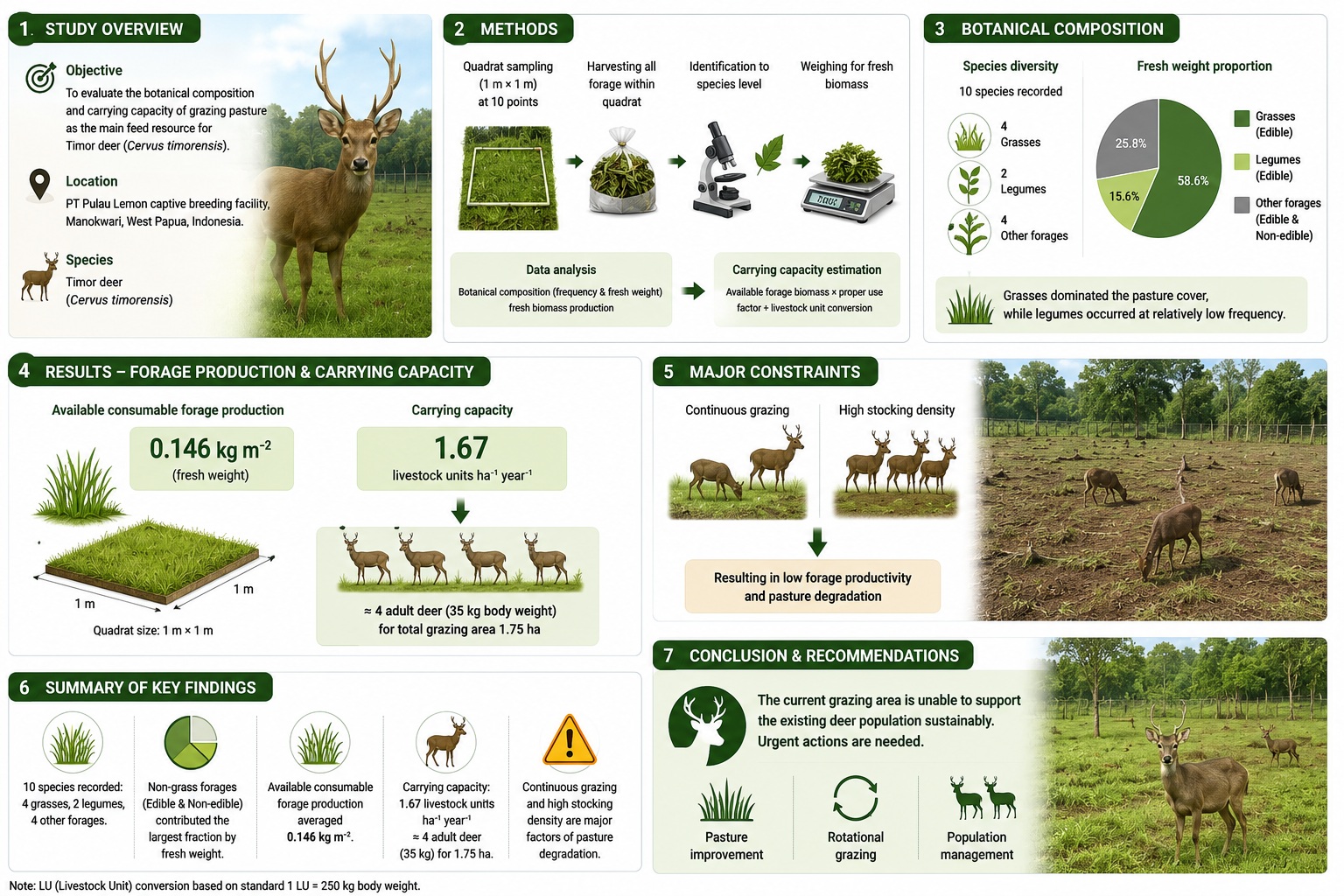
This study aimed to evaluate the botanical composition and carrying capacity of grazing pasture as the main feed resource for Timor deer (Cervus timorensis) at the captive breeding facility of PT Pulau Lemon, Manokwari, West Papua. A descriptive case study approach was applied using quadrat sampling (1 m × 1 m) at ten sampling points representing vegetation heterogeneity and site topography. All forage species within each quadrat were harvested, identified to species level, and weighed to determine fresh biomass production and botanical composition. Carrying capacity was estimated based on available forage biomass, proper use factor, and livestock unit conversion. The results showed that ten plant species were recorded, consisting of four grasses, two legumes, and four other forages. Grasses dominated the pasture cover, while legumes occurred at relatively low frequency. Based on fresh weight proportion, non‑grass forages accounted for the largest fraction, including both edible and non‑edible species. The available consumable forage production averaged 0.146 kg m⁻², resulting in a carrying capacity of only 1.67 livestock units ha⁻¹ year⁻¹, equivalent to approximately four adult deer (35 kg body weight) for the total grazing area of 1.75 ha. Continuous grazing and high stocking density were identified as major factors contributing to low forage productivity and pasture degradation. In conclusion, the current grazing area is unable to support the existing deer population sustainably, indicating an urgent need for pasture improvement, rotational grazing, and population management.
Downloads
References
Benson DE. 2003. Wildlife as a Farm and Ranch Business. Extension 11/98. Colorado State University.
Briske DD, Derner JD, Brown JR, Fuhlendorf SD. 2015. Assessment of grazing management impacts on rangeland vegetation: Ecological mechanisms and management implications. Journal of Environmental Management. 149; 86–97.
DM, Siswadi. 2017. Pengaruh pemberian kombinasi pakan terhadap pertumbuhan rusa Timor (Cervus timorensis) di KHDTK Rarung Lombok Tengah. Prosiding Seminar Nasional Perhutanan Sosial, Lombok Barat.
Dradjat AS. 2014. Teknologi dan Pengelolaan Rusa Indonesia. Gadjah Mada University Press, Yogyakarta.
Graham KL. 2002. Human Influences on Forest Wildlife Habitat. Technical Report GTR SRS-5.
Hempson GP, Archibald S, Bond WJ. 2015. A continent-wide assessment of the form and intensity of large mammal herbivory in Africa. Science. 350(6264); 1056–1061.
Ibrahim M, Camargo J, Villanueva C. 2019. Tropical grassland productivity and carrying capacity under different grazing pressures. Tropical Grasslands – Forrajes Tropicales. 7(2); 152–161.
Infitria I, Khalil K. 2014. Studi produksi dan kualitas hijauan di lahan padang rumput UPT Peternakan Universitas Andalas Padang. Buletin Ilmu Makanan Ternak. 12(1); 25–33.
Jacques CN, Sievers JD, Jenks JA, Sexton CL, Roddy DE. 2006. Evaluating diet composition of pronghorn in Wind Cave National Park, South Dakota. The Prairie Naturalist. 38(4); 301–312.
Junaidi M, Sawen D. 2010. Keragaman botanis dan kapasitas tampung padang penggembalaan alami Kabupaten Yapen. Jurnal Ilmu Peternakan dan Veteriner Tropis. 5(2); 92–97.
Kurniawan D, Putra R. 2019. Feeding ecology of tropical ruminants in semi-natural grassland. Tropical Animal Science Journal. 42(3); 215–224. https://doi.org/10.5398/tasj.2019.42.3.215
Maha IT, Manafe RY, Amalo FA, Selan YN. 2021. Karakteristik morfologi rusa Timor (Cervus timorensis) dengan pemeliharaan ex situ di Kota Kupang. Acta Veterinaria Indonesiana. 9(1); 1–13. https://doi.org/10.29244/avi.9.1.1-13
Mannetje L, Jones RM. 2000. Field and Laboratory Methods for Grassland and Animal Production Research. CABI Publishing. https://doi.org/10.1079/9780851993515.0000
Nurlaha N, Setiana A, Asminaya NS. 2014. Identifikasi hijauan makanan ternak di lahan persawahan Desa Babakan Kecamatan Dramaga Kabupaten Bogor. Jurnal Ilmu dan Teknologi Peternakan Tropis. 1(1); 54–62. https://doi.org/10.33772/jitro.v1i1.361
Pattiselanno F, Gobay A, Pawere FR. 2020. Aktivitas urinasi dan penampakan ekor berdiri tegak sebagai indikator tingkah laku kawin rusa Timor (Cervus timorensis) betina di penangkaran Aro-M Manokwari. Jurnal Ilmu Peternakan dan Veteriner Tropis. 10(2); 86–90. https://doi.org/10.46549/jipvet.v10i2.82
Rahman MMH, Hossain M. 2018. Calcium oxalate-containing aroids and their toxicological effects on livestock. Journal of Veterinary Science and Technology. 9(1); 1–6.
Santosa Y, Susilo H, Arief H. 2021. Dietary selection of free-ranging tropical herbivores: Implications for grassland management. Biodiversitas. 22(4); 1830–1838.
Sari DDK, Astuti MH, Sia LS. 2016. Pengaruh pakan tambahan berupa ampas tahu dan limbah bioetanol berbahan singkong (Manihot utilissima) terhadap penampilan rusa Timor (Cervus timorensis). Buletin Peternakan. 40(2); 107–112. https://doi.org/10.21059/buletinpeternak.v40i2.9191
Catatan: Entri ini pada naskah yang Anda kirim tampak salah (judul menyebut rusa Timor tetapi di akhir tertulis Bos sondaicus dan tahunnya tertulis 2019, sedangkan DOI mengarah ke artikel tahun 2016). Sebaiknya dicek kembali dengan sumber aslinya.
Semiadi G, Nugraha RTP. 2004. Panduan Pemeliharaan Rusa Tropis. Puslit Biologi LIPI, Jakarta.
Susetyo S. 1980. Pengelolaan dan Potensi Hijauan Makanan Ternak untuk Produksi Ternak Daging. Fakultas Peternakan, Institut Pertanian Bogor, Bogor.
Sutomo S, Van EE. 2020. Biomass productivity and adaptive traits of tropical grasses under grazing pressure. Tropical Grasslands – Forrajes Tropicales. 8(3); 123–133.
Syahniar TM, Mazuki A. 2018. A to Z Hijauan Pakan Ternak. Vol. 1. PNJ Press.
Teague WR, Barnes M. 2017. Grazing management that regenerates ecosystem function and grazingland livelihoods. African Journal of Range & Forage Science. 34(2); 77–86. https://doi.org/10.2989/10220119.2017.1334706
Thohari AM, Masyud B, Takanjanji M. 2011. Teknis penangkaran rusa Timor (Cervus timorensis) untuk stok perburuan. Dalam: Sudharma D, Soenarno SM, editor. Prosiding Seminar Sehari "Prospek Penangkaran Rusa Timor (Cervus timorensis) sebagai Stok Perburuan". Bogor.
Van Steenis CGGJ. 1992. Flora. Cetakan ke-5. Penerjemah: M Soeryowinoto. PT Pradnya Paramita, Jakarta.
Downloads
Published
How to Cite
Issue
Section
License
Copyright (c) 2026 Penehas Magai, Evi W. Saragih, Hotlan Manik

This work is licensed under a Creative Commons Attribution-NonCommercial-ShareAlike 4.0 International License.
License and Copyright Agreement
In submitting the manuscript to the journal, the authors certify that:
- They are authorized by their co-authors to enter into these arrangements.
- The work described has not been formally published before, except in the form of an abstract or as part of a published lecture, review, thesis, or overlay journal. Please also carefully read Jurnal Ilmu Peternakan dan Veteriner Tropis (Journal of Tropical Animal and Veterinary Science) Posting Your Article Policy at https://journal.fapetunipa.ac.id/index.php/JIPVET/publicationethics
- That it is not under consideration for publication elsewhere,
- The publication has been approved by all authors and by the responsible authorities, tacitly or explicitly, of the institutions where the work was carried out.
- They secure the right to reproduce any material that has already been published or copyrighted elsewhere.
- They agree to the following license and copyright agreement.
Copyright
Authors who publish with Jurnal Ilmu Peternakan dan Veteriner Tropis (Journal of Tropical Animal and Veterinary Science) agree to the following terms:
- Authors retain copyright and grant the journal right of first publication with the work simultaneously licensed under a Creative Commons Attribution License (CC BY-NC-SA 4.0) that allows others to share the work with an acknowledgment of the work's authorship and initial publication in this journal.
- Authors are able to enter into separate, additional contractual arrangements for the non-exclusive distribution of the journal's published version of the work (e.g., post it to an institutional repository or publish it in a book), with an acknowledgment of its initial publication in this journal.
- Authors are permitted and encouraged to post their work online (e.g., in institutional repositories or on their website) prior to and during the submission process, as it can lead to productive exchanges, as well as earlier and greater citation of published work.

This work is licensed under a Creative Commons Attribution-NonCommercial-ShareAlike 4.0 International License.















.png)
