Pemberdayaan remaja putri melalui program holistik yoga modifikasi untuk peningkatan kesejahteraan biopsikososial
Empowering adolescent girls through a modified holistic yoga program to improve biopsychosocial well-being
DOI:
https://doi.org/10.46549/igkojei.v7i2.667Keywords:
Adolescent girls, Biopsychosocial well-being, Health education, Modified yoga, Peer group, Biopsikososial, Edukasi Kesehatan, Remaja Putri, Yoga ModifikasiAbstract
ABSTRACT
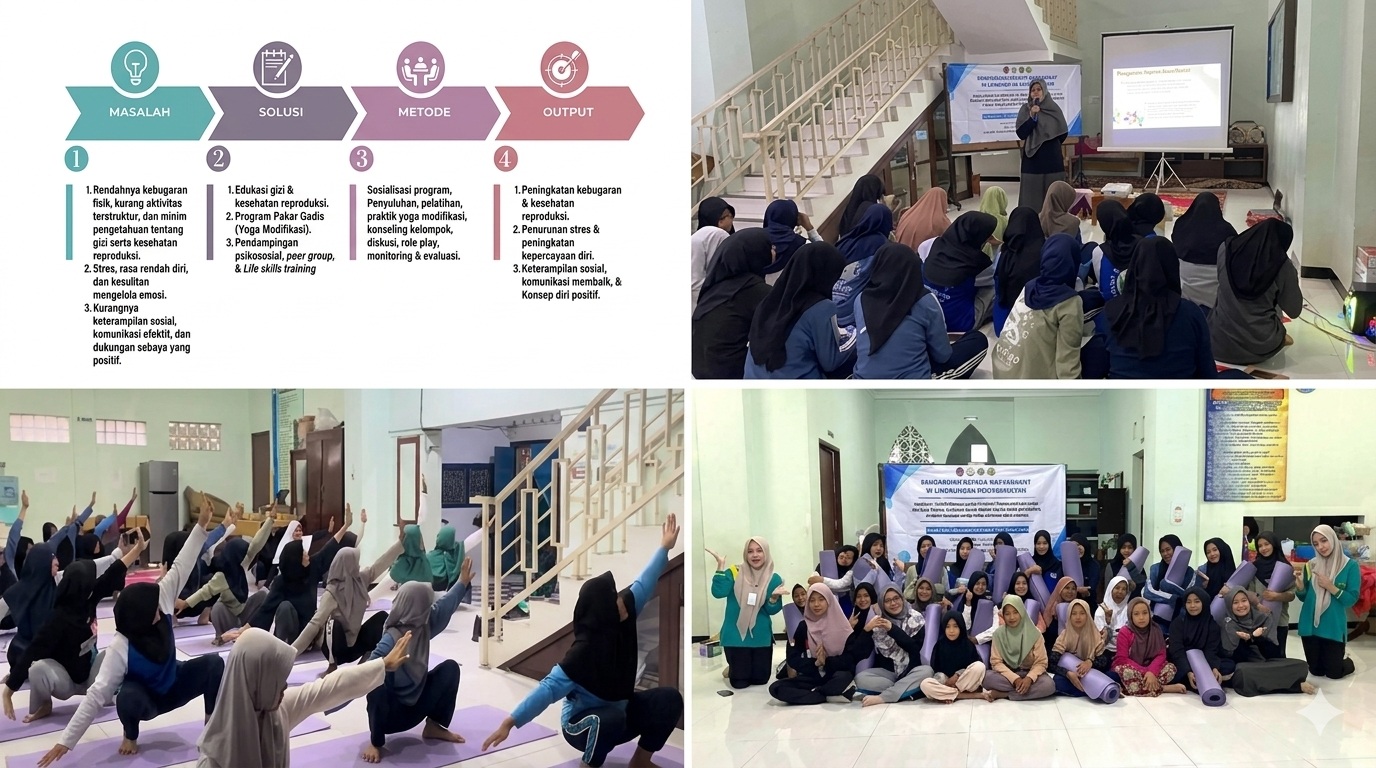
Adolescence is recognized as a critical developmental phase characterized by rapid biological, psychological, and social changes. Adolescent girls living in orphanages are identified as experiencing multiple vulnerabilities, including limited access to reproductive health services, low nutritional knowledge, elevated levels of stress and anxiety, and restricted social skills. These conditions are considered to require holistic and participatory empowerment interventions. The program was developed as a science- and technology-based empowerment model in which nutrition and reproductive health education, modified yoga practice, peer group strengthening through role-play, and life skills training were integrated. This Community Service Program was conducted over eight months at Aisyiyah Putri Orphanage in Pekajangan, Pekalongan Regency, and involved 20 adolescent girls aged 13–18 years. The intervention was implemented through Focus Group Discussions (FGDs), educational sessions, demonstrations, yoga practice delivered by a certified instructor, mentoring activities, and pre–post evaluations using a validated and reliable questionnaire (α = 0.72). Significant improvements in knowledge were observed, with mean scores increasing from 62.5 to 78.4. Reductions in stress levels (20.1 to 14.8) and anxiety (from 18.2 to 12.7), were also recorded, while psychosocial scores were found to improve from 65.7 to 75.2. These findings indicate that a participatory communication approach integrating health education, modified yoga, and peer group activities is effective in strengthening adolescents’ holistic capacities. The program is considered a relevant biopsychosocial empowerment model for orphanage settings and is regarded as having strong potential for sustainability through institutional support and digital-based monitoring systems.
Keywords: Adolescent girls; Biopsychosocial well-being; Health education; Modified yoga; Peer group
ABSTRAK
Masa remaja merupakan fase perkembangan kritis yang ditandai perubahan biologis, psikologis, dan sosial yang cepat. Remaja putri di panti asuhan menghadapi kerentanan ganda, meliputi keterbatasan akses kesehatan reproduksi, rendahnya pengetahuan gizi, masalah psikologis seperti stres dan kecemasan, serta keterbatasan keterampilan sosial. Kondisi tersebut menuntut intervensi pemberdayaan yang holistik dan partisipatif. Program dikembangkan sebagai model pemberdayaan berbasis IPTEKS yang mengintegrasikan edukasi gizi dan kesehatan reproduksi, praktik yoga modifikasi, penguatan peer group melalui role play, serta pelatihan life skills. Kegiatan Pengabdian kepada Masyarakat ini dilaksanakan selama delapan bulan di Panti Asuhan Putri Aisyiyah Pekajangan Kabupaten Pekalongan dengan melibatkan 20 remaja putri usia 13–18 tahun. Metode yang digunakan meliputi Focus Group Discussion (FGD), edukasi, demonstrasi, praktik yoga oleh instruktur bersertifikat, pendampingan, serta evaluasi pre–post menggunakan kuesioner yang telah teruji validitas dan reliabilitasnya (α = 0,72). Hasil evaluasi menunjukkan peningkatan signifikan pada aspek pengetahuan (mean pre-test 62,5 menjadi 78,4), penurunan tingkat stres (20,1 menjadi 14,8) dan kecemasan (18,2 menjadi 12,7), serta peningkatan aspek psikososial (65,7 menjadi 75,2). Temuan ini menunjukkan bahwa pendekatan komunikasi partisipatif melalui integrasi edukasi kesehatan, yoga modifikasi, dan peer group efektif meningkatkan kapasitas remaja putri secara holistik. Program terbukti relevan sebagai model komunikasi pemberdayaan remaja berbasis pendekatan biopsikososial di lingkungan panti asuhan. Program ini berpotensi dikembangkan secara berkelanjutan dengan memperkuat peran pengelola panti dan integrasi media digital untuk mendukung monitoring serta dampak jangka panjang.
Kata kunci: Biopsikososial; Edukasi Kesehatan; Peer Group; Remaja Putri; Yoga Modifikasi
Downloads
References
Aini F, Dyah LPDS, Novitasari D. 2016. Pengaruh senam yoga terhadap tingkat stres pada remaja dalam persiapan menghadapi ujian nasional. Jurnal Ilmiah Kesehatan (JIK). 9(2); 101-109.
Bazzano AN, Sun Y, Chavez-Gray V, Akintimehin T, Gustat J, Barrera D, Roi C. 2022. Effect of yoga and mindfulness intervention on symptoms of anxiety and depression in young adolescents attending middle school: a pragmatic community-based cluster randomized controlled trial in a racially diverse urban setting. International Journal of Environmental Research and Public Health. 19(19); 1-12. https://doi.org/10.3390/ijerph191912076
Chabibah N, Kristiyanti R, Ersila W, Prafitri LD, Rofiqoh S. 2024. The effect of prenatal yoga on discomfort in the third trimester of pregnancy. Proceedings of 5th Borobudur International Symposium on Humanities and Social Science 2023, BISHSS 2023; 1232-1239. https://doi.org/10.2991/978-2-38476-273-6_126
Chabibah N, Susiatmi SA, Fitriyani F, Intan Kusuma N. 2022. Ibu hamil bugar dengan yoga prenatal dan mindfulness. Jurnal Batikmu. 2(2); 29-34. https://doi.org/10.48144/batikmu.v2i2.1359
Dai C, Chen C, Sharma M. 2023. Exploring yoga behaviors among college students based on the multi-theory model (MTM) of health behavior change. International Journal of Environmental Research and Public Health. 20(6395); 1-14. https://doi.org/10.3390/ijerph20146395
Hidayatullah S, Suryono NA, Azizi VH, Amelia I, Rohimah U, Ramadhani NA, Dewanni RTP. 2025. Efektivitas edukasi gizi berbasis pangan lokal dalam meningkatkan pengetahuan dan kesadaran siswa SMP Kabupaten Lembata Nusa Tenggara Timur. Jurnal Surya Masyarakat. 7(2); 301-310. https://doi.org/10.26714/jsm.7.2.2025.301-310
Khuzaiyah S, Muthoharoh A, Chabibah N. 2019. Satisfaction and motivation of adolescents attending a comprehensive teenage health services of Nasyiatul Aisyiyah. KnE Life Sciences. 4(13); 304-315. https://doi.org/10.18502/kls.v4i13.5260
Prafitri LD, Fitriyani, Aisyah RD. 2019. Kelompok remaja sehat reproduksi di MTs Muhammadiyah Pekajangan Pekalongan. Jurnal Pengabdian Masyarakat Kesehatan. 5(2); 22-27. https://doi.org/10.33023/jpm.v5i2.464
Prafitri LD, Suparni. 2018. Pendidikan kesehatan reproduksi remaja untuk mencegah perilaku negatif remaja. Proceeding The 8th University Research Colloquium 2018 Universitas Muhammadiyah Purwokerto; 313-317. http://repository.urecol.org/index.php/proceeding/issue/view/15
Putri NA, Anwar M. 2025. Edukasi branding strategi usaha keripik ampas tebu sachiips pada santri Pondok Pesantren Al Usmaniyah. IGKOJEI: Jurnal Pengabdian Masyarakat. 6(2); 76-84. https://doi.org/10.46549/igkojei.v6i2.533
Rahmah WN, Sartika F, Ramdhani FH, Hidayani A, Handayani R. 2025. Edukasi dan penguatan kapasitas remaja dalam pengendalian dan pencegahan dini penyakit infeksi menular seksual (PIMS) di SMA Muhammadiyah 1 Palangka Raya. Journal of Community Development. 6(1); 168-177. https://doi.org/10.47134/comdev.v6i1.1680
Sari AN, Rahma A. 2024. Peran edukasi gizi berbasis budaya dalam meningkatkan kesadaran remaja terhadap asupan makanan lokal. Jurnal Ilmiah PANNMED (Pharmacist, Analyst, Nurse, Nutrition, Midwivery, Environment, Dentist). 19(3); 307-314. https://doi.org/10.36911/pannmed.v19i3.2203
Servaes J. 2016. Communication for Development and Social Change.
Sinuraya S, Kawulur EIJ, Dwiranti F, Panjaitan R, Ratnawati S. 2021. Edukasi perilaku hidup bersih dan sehat (PHBS) pada anak-anak di Kampung Pemekaran Mister Ngiosi Manokwari pada masa pandemi COVID-19. IGKOJEI: Jurnal Pengabdian Masyarakat. 2(3); 106-113. https://doi.org/10.46549/igkojei.v2i3.241
UNICEF. 2024. Adolescent Girls' Programme: Research brief (Indonesia).
Vollbehr NK, Hoenders HJR, Bartels-Velthuis AA, Nauta MH, Castelein S, Schroevers MJ, Stant AD, de Jong PJ, Ostafin BD. 2020. A mindful yoga intervention for young women with major depressive disorder: design and baseline sample characteristics of a randomized controlled trial. International Journal of Methods in Psychiatric Research. 29(2); 1-13. https://doi.org/10.1002/mpr.1820
WHO. 2025. Mental health of adolescents. Tersedia pada: https://www.who.int/news-room/fact-sheets/detail/adolescent-mental-health
Downloads
Published
How to Cite
Issue
Section
License
Copyright (c) 2026 Lia D. Prafitri, Wahyu Ersila, Nur Chabibah, Lailatun Nashiroh, Sabrina S. Nada

This work is licensed under a Creative Commons Attribution-NonCommercial-ShareAlike 4.0 International License.
License and Copyright Agreement
In submitting the manuscript to the journal, the authors certify that:
- They are authorized by their co-authors to enter into these arrangements.
- The work described has not been formally published before, except in the form of an abstract or as part of a published lecture, review, thesis, or overlay journal. Please also carefully read IGKOJEI: Jurnal Pengabdian Masyarakat Posting Your Article Policy at https://journal.fapetunipa.ac.id/index.php/igkojei/policy/publicationethics
- That it is not under consideration for publication elsewhere,
- That its publication has been approved by all the author(s) and by the responsible authorities – tacitly or explicitly – of the institutes where the work has been carried out.
- They secure the right to reproduce any material that has already been published or copyrighted elsewhere.
- They agree to the following license and copyright agreement.
Copyright
Authors who publish withIGKOJEI: Jurnal Pengabdian Masyarakat agree to the following terms:
- Authors retain copyright and grant the journal right of first publication with the work simultaneously licensed under a Creative Commons Attribution License (CC BY-NC-SA 4.0) that allows others to share the work with an acknowledgment of the work's authorship and initial publication in this journal.
- Authors are able to enter into separate, additional contractual arrangements for the non-exclusive distribution of the journal's published version of the work (e.g., post it to an institutional repository or publish it in a book), with an acknowledgment of its initial publication in this journal.
- Authors are permitted and encouraged to post their work online (e.g., in institutional repositories or on their website) prior to and during the submission process, as it can lead to productive exchanges, as well as earlier and greater citation of published work.

This work is licensed under a Creative Commons Attribution-NonCommercial-ShareAlike 4.0 International License.