Mendekonstruksi mitos budaya pada pembangunan desa wisata Gintangan di Banyuwangi
Deconstructing cultural myths in the development of the Gintangan tourist village in Banyuwangi
DOI:
https://doi.org/10.46549/igkojei.v7i1.613Keywords:
deconstruction, cultural myths, tourism village, Gintangan, Banyuwangi, Dekonstruksi, Mitos Budaya, Pembangunan Desa WisataAbstract
ABSTRACT
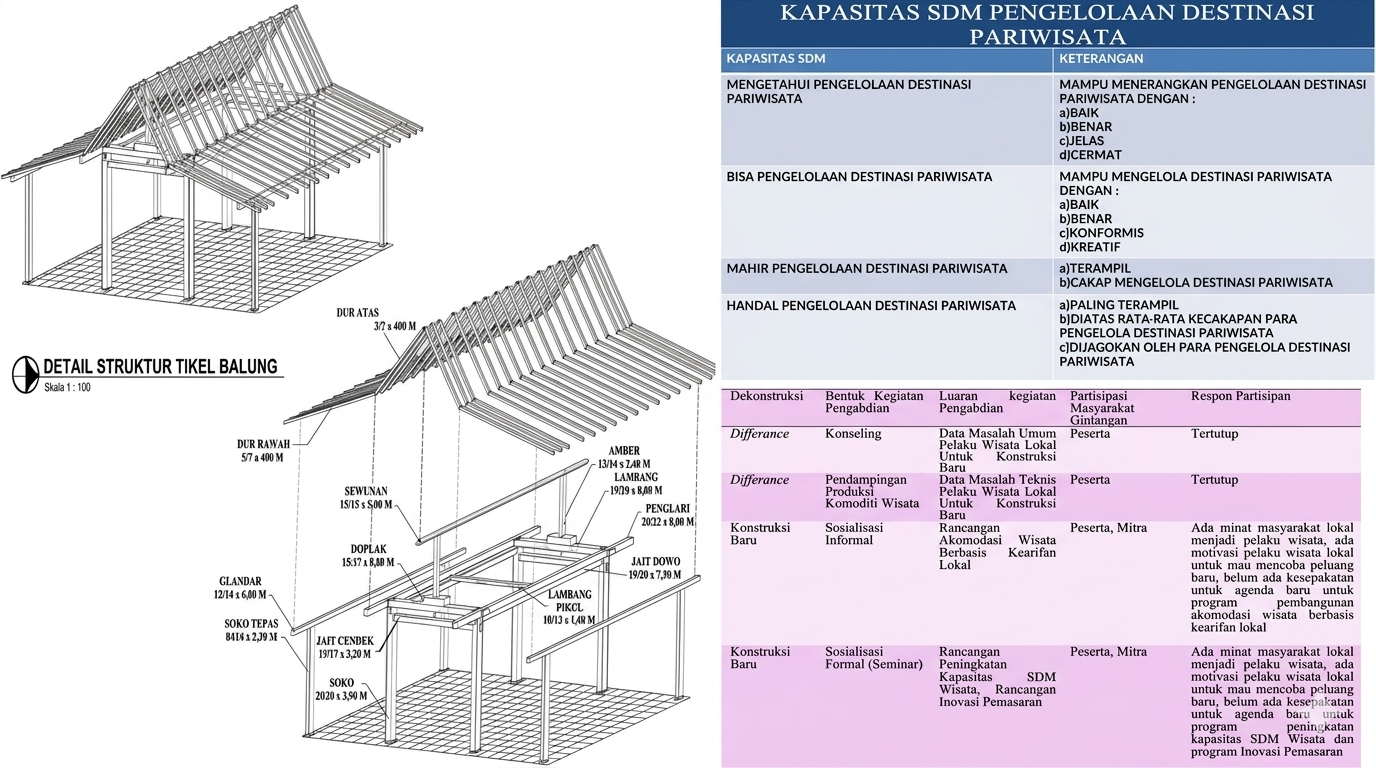
Deconstructing cultural myths in the Gintangan Tourism Village is a focus in efforts to strengthen local tourism competitiveness during the IPBI TPPP Master's p.c.s activities in the village of Gintangan. The Gintangan people already have solutions for developing local tourism potential based on cultural myths. However, it turns out that some of them are reluctant to local brand tourism commodities because of cultural myths. The issues are : 1) What is the impact of Gintangan cultural myths?; 2) How does diffrance respond to Gintangan cultural myths?; 3) How is a new construction being built amid Gintangan cultural myths in the development of the Gintangan tourist village?. These issues were resolved using qualitative methods. The results show : 1) Gintangan cultural myths have had impacts on collective pride, economic enablers, bamboo innovation, bamboo weaving education centers, bamboo houses, bamboo-themed meeting halls, bamboo-themed costume designs, bamboo festivals, symbolic dependencies, and product branding.; 2) Cultural myths are diffracted by suspending old solutions and designing new ones while analyzing the situation, opening counseling services, providing assistance in the creation of tourism commodities, and ensuring and perfecting new solutions to the problems of improving the quality of tourism village development desired by the actors. 3) New construction for the development of Gintangan Tourism Village in the form of promotional innovation designs, human resource capacity building designs, and tourism facility designs based on strategically developed local tourism capital to revitalize the local brand image competitiveness of Gintangan Tourism Village.
Keywords: deconstruction, cultural myths, tourism village, Gintangan, Banyuwangi.
ABSTRAK
Dekonstruksi Mitos Budaya pada pembangunan Desa Wisata Gintangan merupakan sebuah konsentrasi dalam usaha penguatan daya saing wisata lokal selama kegiatan pengabdian S2 TPPP IPBI kepada masyarakat desa Gintangan. Masyarakat desa Gintangan telah memiliki solusi pengembangkan potensi wisata lokal berdasarkan mitos budaya. Akan tetapi, ternyata diantara mereka enggan membranding komoditi wisata dengan identitas lokal karena mitos budaya. Permasalahannya : 1) Apa dampak mitos budaya Gintangan?; 2) Bagaimana tindakan diffrance atas mitos budaya Gintangan?; 3) Bagaimana konstruksi baru ditengah praktik mitos budaya dalam pembangunan desa wisata Gintangan?. Permasalahan ini diselesaikan dengan menggunakan metode kualitatif. Hasil analisis kegiatan menunjukan : 1) Mitos budaya Gintangan telah berdampak positif terhadap collective pride, economic enabler, inovasi karya bambu, pusat edukasi kerajinan anyaman bambu, griya bambu, balai pertemuan bermotif bambu, model kostum bermotif bambu, festival bambu, depedensi simbolik, branding produk yang sangat potensial menjadi bagian dari pembangunan nilai kualitas desa wisata Gintangan.; 2) Diffrance mitos budaya dilakukan dengan menangguhkan solusi lama dan rancangan solusi baru sambil melakukan analisis situasi, membuka layanan konseling, melakukan pendampingan pembuatan komoditi wisata, memastikan dan menyempurnakan solusi baru untuk masalah peningkatan kualitas pembangunan desa wisata yang diinginkan pelaku.; 3) Konstruksi baru untuk pembangunan Desa Wisata Gintangan berupa rancangan inovasi promosi, rancangan peningkatan kapasitas SDM dan rancangan sarana wisata berbasis modal wisata lokal yang strategis dikembangkan untuk merevitalisasi daya saing brand image lokal dari desa wisata Gintangan.
Kata kunci: Dekonstruksi, Mitos Budaya, Pembangunan Desa Wisata, Gintangan, Banyuwangi.
Downloads
References
Aguilar EDM, Witjes S, Bos RT. 2025. Deconstruction as a research strategy for discourse studies: an aporetic and iterable model for opening discourse. Internasional Journal of Qualitative Methods. 24(1); 1–16. https://doi.org/10.1177/16094069251349470
Agus Salim H, Untari D, Hamliyah H. 2023. Pendampingan produktivitas UMKM UD. Widya Handicraft pasca pandemi Covid-19 Desa Gintangan, Kec. Blimbingsari, Kab. Banyuwangi. Jurnal Pengabdian Masyarakat. 3(1); 12–20. https://doi.org/10.31967/jpm.v3i1.870
Bourdieu P. 1986. The forms of capital. In: Ricardson (ed.). Handbook of Theory and Research for the Sociology of Education; 241–258. Greenwood Press, New York.
BPS. 2023. Statistik Objek Daya Tarik Wisata 2023. BPS, Jakarta.
Cole S. 2007. Beyond authenticity and comodification. Annals of Tourism Research. 34(4); 943–960. https://doi.org/10.1016/j.annals.2007.05.004
Dionisio M, Silva CPD, Almeida P, Marques CG, Simoes JT, Domingos S. 2024. Local cultural identity as a tourism development agent. Journal of Tourism and Heritage Research. 7(3); 81–88.
Eliade M. 1963. Myth and Reality. Harper & Row, New York.
Febriyanti PA, Fitriyah R, Arifiyanti J. 2024. Mekanisme survival petani buah naga di Dusun Rejoagung, Desa Sumberagung, Kabupaten Banyuwangi. Jurnal Sosial Terapan. 2(1); 41–47. https://doi.org/10.29244/jstr.2.1.41-47
Garanti. 2024. Sustainable place branding and visitors' response: a systematic literature review. Sustainability. 16(8); 1–15. https://doi.org/10.3390/su16083312
Geertz C. 1973. The Intepretation of Cultures: Selected Essays. Basic Books, New York.
Hartini FS, Mecha IPS, Sanjaya AW. 2021. Penguatan brand image Sego Jajang guna membangun reputasi culinary tourism di Desa Gintangan. Jurnal Destinasi Pariwisata. 9(2); 296–304. https://doi.org/10.24843/JDEPAR.2021.v09.i02.p07
Herlina H, Utami ES, Fauziah RR, Lindriati T, Harsita PA, Wiyono AE, Indraningrat K. 2022. Development of Bagiak business (Osing ethnic snacks) through the production of rich fiber Bagiak and bussines model canvas application (BMC). Jurnal Hasil Pengabdian Kepada Masyarakat Universitas Jember. 1(2); 71–77. https://doi.org/10.19184/jpmunej.v1i2.211
Koentjaraningrat. 2009. Pengantar Ilmu Antropologi. Rineka Cipta, Jakarta.
Kemenparekraf. 2021. Anugerah Desa Wisata Indonesia (ADWI) 2021. Kemenparekraf RI, Jakarta.
Kemenparekraf. 2020. Rencana Strategis Kementrian Pariwisata dan Ekonomi Kreatif Tahum 2020–2024 (Renstra 2020–2024). Kemenparekraf RI, Jakarta.
Kemenparekraf. 2022. Laporan Kinerja Kementrian Pariwisata dan Ekonomi Kreatif Tahun 2022. Kemenparekraf RI, Jakarta.
Kemenparekraf. 2022a. Statistik Tenaga Kerja Pariwisata dan Ekonomi Kreatif 2018–2022. BPS & Kemenparekraf RI, Jakarta.
Lapadi I, Widiastuti N, Irmawati FES, Mudjirahayu P, Bayu P, Manangkalangi TF, Emmanuel, Sabariah V. 2023. Peningkatan fasilitas penangkaran penyu melalui pembuatan bak penangkaran, pondok wisata dan media penyuluhan. IGKOJEI: Jurnal Pengabdian Masyarakat. 4(2); 104–111. https://doi.org/10.46549/igkojei.v4i2.380
Levi-Strauss C. 1969. The Elementary Structures of Kinship. Beacon Press, Boston.
Permatasari SJ. 2022. Pengembangan program desa wisata berbasis jejaring bisnis di Desa Tamansari Kabupaten Banyuwangi. Governance: Jurnal Kebijakan dan Manajemen Publik. 12(2); 133–139. https://doi.org/10.38156/gjkmp.v12i2.107
Picard M. 1996. Bali: Cultural Tourism and Touristic Culture. Archipelago Press, Singapura.
Philip J, Newman J, Bifelt J, Brooks C, Rivkin I. 2022. Role of social, cultural and symbolic capital for youth and community wellbeing in a rural Alaska Native community. Child Youth Serv Rev. 137(1); 1–23. https://doi.org/10.1016/j.childyouth.2022.106459
Pradana GYK, Arcana KTP. 2020. Hasil pengelolaan homestay bercorak budaya tradisional Bali ditengah pengaruh perkembangan trend millennial di sektor pariwisata. Jurnal Ilmiah Hospitality Management. 11(1); 1–14. https://doi.org/10.22334/jihm.v11i1.172
Pradana GYK, Jayendra PS. 2024. Panca Maha Bhuta service: a health service innovation based on Balinese wisdom at the Fivelements Retreat Bali Hotel. International Journal of Humanities and Social Sciences. 14(1); 116–129. https://doi.org/10.30845/ijhss.v14p13
Pradana GYK, Parwati KSM. 2017. Local-wisdon-based spa tourism in Ubud Village of Bali, Indonesia. Russian Journal of Agricultural and Socio-Economic Sciences. 8(68); 188–196. https://doi.org/10.18551/rjoas.2017-08.22
Pradana GYK, Ruastiti NM. 2022. Imitating the emancipation of Hindu female characters in Balinese wayang legends. International Journal of Social Sciences. 5(1); 643–656. https://doi.org/10.53625/ijss.v1i5.1307
Pradana GYK, Sanjaya IWK, Wahyu GE. 2025. Praxis Beach Clean Up di Pantai Mertasari dalam rangka Dies Natalis IPB Internasional. Jurnal Pengabdian Masyarakat Mentari. 1(11); 444–460.
Pradana GYK, Sattvika IPAE, Pradana KAW. 2025. Gamelan Gong Beri in Balinese culture. International Journal of Society Reviews. 2(11); 2070–2089.
Pradana GYK, Semadi IGN, Entas D, Suadnyana IW. 2025. Agrotourism strategies in Tenganan indigenous environmental stewardship: an implementation of community-oriented sustainable tourism. Jurnal Intelek dan Cendikiawan Nusantara. 2(4); 5507–5519.
Pradana GYK, Suarka IN, Wirawan AAB, Dhana IN. 2016. Religious ideology of the tradition of makotek in the era globalization. Electronic Journal of Cultural Studies. 9(1); 6–10.
Pradana GYK, Wijaya IN, Purnaya IGK. 2024. Representation of cross-cultural relations in the Bali Agung Theater at Taman Safari & Marine Park Bali: a discourse in Balinese performing arts. Mudra: Jurnal Seni Budaya. 39(3); 415–424. https://doi.org/10.31091/mudra.v39i3.2813
Pradana GYK. 2012. Diskursus fenomena hamil di luar nikah dalam pertunjukan Wayang Joblar. Electronic Journal of Cultural Studies. 1(1); 11–27.
Pradana GYK. 2018. Implications of commidified Parwa shadow puppet performance for tourism in Ubud, Bali. Journal of Business on Hospitality and Tourism. 4(1); 70–79. https://doi.org/10.22334/jbhost.v4i1.103
Pradana GYK. 2021. Aplikasi filosofi Tri Hita Karana dalam pemberdayaan masyarakat Tonja di Denpasar: application of the Tri Hita Karana philosophy in empowering Tonja society in Denpasar. Jurnal Abdi Masyarakat. 1(2); 61–71. https://doi.org/10.22334/jam.v1i2.10
Pradana GYK. 2022. Animo dosen STPBI dalam Gerakan Semesta Berencana Bali Resik Sampah Plastik di Karangasem. Swarna: Jurnal Pengabdian Kepada Masyarakat. 1(3); 245–255. https://doi.org/10.55681/swarna.v1i3.115
Pradana GYK. 2022. Mereresik dan penghijauan dalam rekognisi perayaan Hari Ulang Tahun Kemerdekaan Republik Indonesia. Jurnal Pengabdian Mandiri. 1(6); 1101–1112.
Pradana GYK. 2023. Membangun makna hospitality melalui program kemitraan masyarakat Go Green Go Clean di Pura Luhur Batukaru Tabanan, Bali. Pakdemas: Jurnal Pengabdian Kepada Masyarakat. 3(1); 1–10. https://doi.org/10.58222/pakdemas.v3i1.183
Pradana GYK. 2023. The meaning of Pancasila in the tradition of Subak management: a reflection of Pancasila values in the Balinese venture for the next generation of food security. International Journal of Social Science and Human Research. 6(6); 3537–3543.
Pradana GYK. 2024. Peran civitas akademika IPBI dalam menjalin makna sosial pada kegiatan Beach Clean Up di Kuta. Jurnal Masyarakat Bangsa. 2(1); 77–89. https://doi.org/10.59837/jpmba.v2i1.775
Pradana GYK. 2025. Deconstruction powers of relations behind the shadow puppet performance for tourism in Ubud Village Bali. Soko Guru: Jurnal Ilmiah Pendidikan. 5(2); 226–236. https://doi.org/10.55606/sokoguru.v5i2.5768
Qiu L, Rahman ARA, Dolah M, Shahrizal B. 2024. The role of souvenirs in enhancing local cultural sustainability: a systematic literature review. Sustainability. 16(10); 1–25. https://doi.org/10.3390/su16103893
Rosita PA, Savitri FAN, Akkapin S. 2024. Cultural richness of Osing as a main attraction for sustainable tourism in Kemiren Village, Banyuwangi. Siwayang Journal. 3(3); 131–140. https://doi.org/10.54443/siwayang.v3i3.1717
Salim HA, Untari D, Hamiliyah. 2023. Pendampingan produktivitas UMKM UD. Widya Handicraft pasca pandemi Covid-19 Desa Gintangan, Kec. Blimbingsari, Kab. Banyuwangi. JPM: Jurnal Pengabdian Masyarakat. 3(1); 12–20. https://doi.org/10.31967/jpm.v3i1.870
Sari DK, Sunaryo H, Farida E. 2024. Strategi pengembangan usaha mikro kecil menengah (UMKM) berbasis ekonomi kreatif. Jurnal Solma. 13(2); 1007–1011. https://doi.org/10.47861/sammajiva.v2i2.980
Suci CW, Yustita AD, Putra AP. 2021. Pengaruh penerapan konsep pariwisata berkelanjutan terhadap kepuasan wisatawan di Taman Gandrung Terakota Banyuwangi. Sadar Wisata: Jurnal Pariwisata. 4(2); 43–50. https://doi.org/10.32528/sw.v4i2.5928
UNWTO. 2018. Tourism and the Sustainable Development Goals-Journey to 2030. UNWTO, Madrid.
UNWTO. 2021. Tourism for Rural Development: Empowering Communities. UNWTO, Madrid.
Wulandari M, Wahyuni S, Zulianto M. 2021. Strategi diversifikasi produk pada UMKM kerajinan bambu di Desa Gintangan Kecamatan Blimbingsari Kabupaten Banyuwangi. Jurnal Pendidikan Ekonomi. 15(1); 103–109.
Yuliani MGA, Ma’ruf A, Yuliawan R, Rochmi SE. 2024. Program penggemukan ternak sapi potong dan pembentukan kelompok ternak Armada di Kawasan Ekonomi Khusus Mandalika Kabupaten Lombok Tengah Nusa Tenggara Barat. IGKOJEI: Jurnal Pengabdian Masyarakat. 5(3); 93–98. https://doi.org/10.46549/igkojei.v5i3.438
Yen D, Jang J, Wei L, Morgan N, Pritchard A. 2023. Leveraging folklore and fantasy to promote small destinations: the case of Visit Wales. Journal of Policy Research in Tourism, Leisure and Events. 1(1); 1–15.
Zazilah AN, Mecha IPS. 2021. Kelanjutan eksistensi kerajinan bambu Desa Gintangan dengan model matematika sebagai daya tarik wisata Desa Gintangan. Jurnal Karya Pendidikan Matematika. 8(1); 18–24. https://doi.org/10.26714/jkpm.8.1.2021.18-24
Zazilah AN, Mecha IPS, Nurhalimah. 2023. Peningkatan market value produk lokal gula semut Banyuwangi melalui optimalisasi kualitas dan rebranding produk. Integritas: Jurnal Pengabdian. 7(2); 450–458. https://doi.org/10.36841/integritas.v7i2.3672
Zeqiri A, Youssef AB, Zahar TM. 2025. The role of digital tourism platform in advancing sustainable development goals in the Industry 4.0 era. Sustainability. 17(8); 1–24. https://doi.org/10.3390/su17083482
Downloads
Published
How to Cite
Issue
Section
License
Copyright (c) 2026 Gede Yoga Kharisma Pradana, Ida Bagus Putu Wira Diana, Dedy Sumardi, Gema Sukana Putra, Putu Ayu Permatasari, I Gusti Agung Ngurah Dharma Suyasa

This work is licensed under a Creative Commons Attribution-NonCommercial-ShareAlike 4.0 International License.
License and Copyright Agreement
In submitting the manuscript to the journal, the authors certify that:
- They are authorized by their co-authors to enter into these arrangements.
- The work described has not been formally published before, except in the form of an abstract or as part of a published lecture, review, thesis, or overlay journal. Please also carefully read IGKOJEI: Jurnal Pengabdian Masyarakat Posting Your Article Policy at https://journal.fapetunipa.ac.id/index.php/igkojei/policy/publicationethics
- That it is not under consideration for publication elsewhere,
- That its publication has been approved by all the author(s) and by the responsible authorities – tacitly or explicitly – of the institutes where the work has been carried out.
- They secure the right to reproduce any material that has already been published or copyrighted elsewhere.
- They agree to the following license and copyright agreement.
Copyright
Authors who publish withIGKOJEI: Jurnal Pengabdian Masyarakat agree to the following terms:
- Authors retain copyright and grant the journal right of first publication with the work simultaneously licensed under a Creative Commons Attribution License (CC BY-NC-SA 4.0) that allows others to share the work with an acknowledgment of the work's authorship and initial publication in this journal.
- Authors are able to enter into separate, additional contractual arrangements for the non-exclusive distribution of the journal's published version of the work (e.g., post it to an institutional repository or publish it in a book), with an acknowledgment of its initial publication in this journal.
- Authors are permitted and encouraged to post their work online (e.g., in institutional repositories or on their website) prior to and during the submission process, as it can lead to productive exchanges, as well as earlier and greater citation of published work.

This work is licensed under a Creative Commons Attribution-NonCommercial-ShareAlike 4.0 International License.