The use of acetic acid bacteria isolated from palm vinegar to reduce the growth of Escherichia coli in white rats (Rattus norvegicus)
DOI:
https://doi.org/10.46549/jipvet.v16i2.653Keywords:
Acetic acid bacteria, Escherichia coli, Palm vinegar, Secum, Wistar ratsAbstract
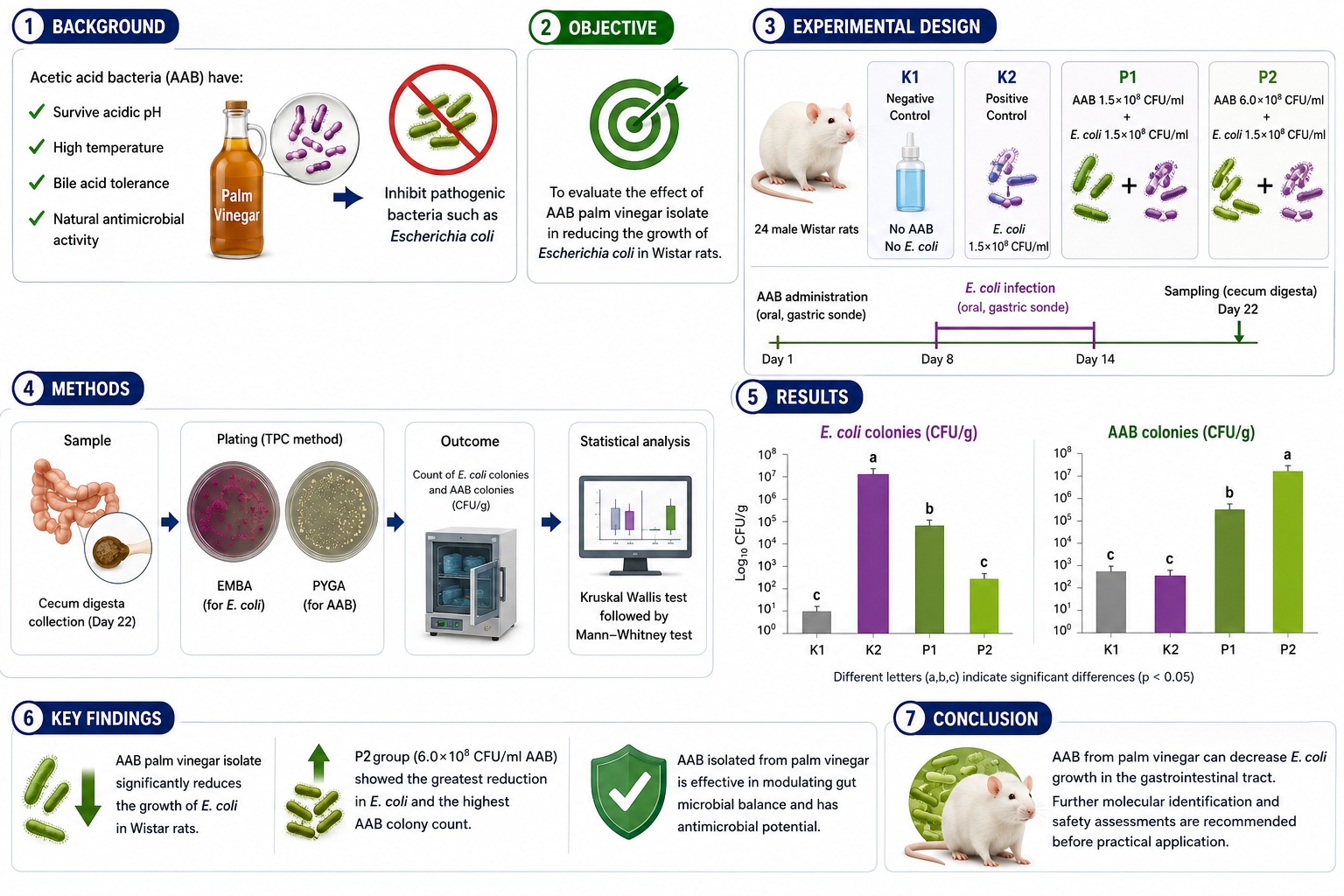
Acetic acid bacteria (AAB) have the potential to become the next generation of probiotics due to their ability to survive in acidic pH conditions, high temperatures, and exposure to bile acids. In addition, acetic acid bacteria are also known to have natural antimicrobial effects that can inhibit the growth of pathogenic bacteria such as Escherichia coli. This study was conducted to examine the effectiveness of acetic acid bacteria isolate cuka aren as a probiotic candidate in inhibiting the growth of Escherichia coli in white rats (Rattus norvegicus). This study used 24 male Wistar rats divided into four treatment groups, namely (K1) negative control, (K2) positive control, (P1) acetic acid bacteria 1.5 x 10⁸ CFU/ml + pathogenic E. coli 1.5 x 10⁸ CFU/ml, and (P2) acetic acid bacteria 6.0 x 10⁸ CFU/ml + pathogenic E. coli 1.5 x 10⁸ CFU/ml. Acetic acid bacteria were administered orally via a gastric tube on days 1 to 21. Pathogenic E. coli infection was performed orally using a gastric tube on days 8 to 14. Sampling of rat cecal digesta was performed on day 22, and the number of E. coli colonies was counted on Eosin Methylene Blue Agar (EMBA) medium and acetic acid bacteria on Pepton Yeast Glucose Agar (PYGA) medium using the Total Plate Count (TPC) method. The data obtained were analyzed using the Kruskal Wallis statistical test and followed by the Mann-Whitney test. Based on the results of the study, acetic acid bacteria isolated from palm vinegar were proven to be able to reduce the growth of E. coli in white mice, with group P2 being the most effective treatment because it showed a decrease in the number of E. coli and the highest growth in the number of acetic acid bacteria colonies.
Downloads
References
Abubakar Y, Widayat HP, Muzaifa M, Mega FA. 2020. Isolasi dan identifikasi bakteri asam asetat dari fermentasi kakao Aceh. Jurnal Teknologi Pertanian Andalas. 24(1); 23–28.
Agustina DC, Yulvizar N, Risa. 2013. Isolasi dan karakterisasi bakteri pada ikan kembung (Rastrelliger sp.) asin berkitosan. Biospecies. 6(1); 15–19. https://doi.org/10.22437/biospecies.v6i1.685
Al-Kharousi ZS. 2025. Highlighting lactic acid bacteria in beverages: Diversity, fermentation, challenges, and future perspectives. Foods. 14(12); 2043. https://doi.org/10.3390/foods14122043
Arianty D, Mahmud NA, Ernawati E. 2024. Chemical characterization and microbiology of Khalas's date vinegar (Phoenix dactylifera). Jurnal Teknologi Hasil Pertanian. 17(1); 70–86. https://doi.org/10.20961/jthp.v17i1.77604
Arief II, Jenie BS, Astawan M, Witarto AB. 2010. Efektivitas probiotik Lactobacillus plantarum 2C12 dan Lactobacillus acidophilus 2B4 sebagai pencegah diare pada tikus percobaan. Tropical Animal Science Journal. 33(3); 137–142. https://doi.org/10.5398/medpet.2010.33.3.137
Firdausy AF. 2024. Monograf Bakteri Asam Laktat Versus Patogen: Tinjauan Potensi Antibakteri Isolat Bakteri Asam Laktat Terhadap Staphylococcus aureus, Escherichia coli, dan Klebsiella pneumoniae. CV Budi Utama, Sleman.
Han D, Yang Y, Guo Z, Dai S, Jiang M, Zhu Y, Wang Y, Yu Z, Wang K, Rong C, Yu Y. 2024. A review on the interaction of acetic acid bacteria and microbes in food fermentation: A microbial ecology perspective. Foods. 13; 2534. https://doi.org/10.3390/foods13162534
Handayani YD. 2024. Isolasi dan Identifikasi Bakteri Acetobacter aceti dari Cuka Aren (Arenga pinnata). Skripsi. Universitas Syiah Kuala, Banda Aceh.
Hartanto WA, Hendrayana MA, Budayanti NNS. 2023. Identifikasi kontaminasi bakteri Escherichia coli O157 pada daging sapi di pasar tradisional Kota Denpasar. Intisari Sains Medis. 14(3); 1287–1293.
Ilahi BR, Handayani YD, Azhari, Rastina, Darniati. 2025. Effectiveness of Acetobacter aceti bacteria from palm vinegar (Arenga pinnata) isolate on acid and bile salt resistance as a probiotic candidate. IOP Conference Series: Earth and Environmental Science. 1476(1); 012083. https://doi.org/10.1088/1755-1315/1476/1/012083
Irhamni, Diana, Saudah, Ernilasari, Suzanni MA, Mulyati D, Hakim L. 2019. Fermentasi limbah kulit durian menjadi cuka organik dengan menggunakan Acetobacter aceti. Journal of Islamic Science and Technology. 5(1); 16–20. https://doi.org/10.22373/ekw.v5i1.3902
James TS, David RB, Don JB, Paul DV, George MG, Michael G, Noel RK, Fred AR, Karl HS. 2005. Bergey's Manual of Systematic Bacteriology. Second Edition. Volume 2 Part C. Department of Microbiology and Molecular Genetics, Michigan State University.
Lestari LA, Helmayati S. 2018. Peran Probiotik di Bidang Gizi dan Kesehatan. Gadjah Mada University Press, Yogyakarta.
Maal KB, Rasoul S, Noushin K. 2010. Production of apricot vinegar using an isolated Acetobacter strain from Iranian apricot. International Journal of Biological and Life Sciences. 6(4); 230–233.
Mardiyantoro F, Munika K, Susanti V, Cahyati M, Pratiwi AR. 2018. Penyembuhan Luka Rongga Mulut. UB Press, Malang.
Nasrollahian S, Graham JP, Halaji M. 2024. A review of mechanisms that confer antibiotic resistance in pathotypes of Escherichia coli. Frontiers in Cellular and Infection Microbiology. 14. https://doi.org/10.3389/fcimb.2024.1387497
Pavantheja V, Manikandan S. 2023. Using a chemical titration technique: A comparison of the efficiency of organic grape juice vinegar and commercially available vinegar for the evaluation of chicken quality. Journal of Survey in Fisheries Sciences. 10(15). https://doi.org/10.18137/cardiometry.2022.25.10701075
Putra DC, Humaidah N. 2022. Efektivitas probiotik sebagai pengganti antibiotic growth promotor (AGP) pada unggas (artikel review). Dinamika Rekasatwa: Jurnal Ilmiah. 5(2).
Rafika M, Lestari LA, Helmayati S. 2023. Fortifikasi besi dan prebiotik pada kukis terhadap histologi usus tikus anemia. Jurnal Gizi Klinik Indonesia. 19(4); 173–182. https://doi.org/10.22146/ijcn.42606
Rahmawati, Isnaeni D. 2016. Isolasi dan karakterisasi mikrosimbion dari spons Callyspongia vaginalis dan uji daya hambat terhadap Staphylococcus aureus dan Salmonella typhi. The National Journal of Pharmacy. 13(2); 8–19.
Ranim YR, Salamah, Rusydi R, Mahdaliana, Mainisa. 2022. Efektivitas pemberian probiotik untuk meningkatkan pertumbuhan benih ikan kakap putih air tawar (Lates calcarifer). Jurnal Ilmiah Samudra Akuatika. 6(2); 69–77.
Rath C, Jape GA, Rao S, Patole S. 2023. Effect of probiotic dose escalation on gut microbiota and clinical outcomes in preterm infants. Children. 10; 1710. https://doi.org/10.3390/children10101710
Sholiha M, Antara NS, Putra GPG. 2025. Karakteristik vinegar nira aren pada variasi penambahan gula dan lama fermentasi aerobik. Jurnal Ilmiah Teknologi Pertanian. 10(2); 23–36.
Wahyuni RM, Sayuti A, Abrar M, Erina, Hasan M, Zainuddin. 2018. Isolasi dan identifikasi bakteri enterik patogen pada badak Sumatera (Dicerorhinus sumatrensis) di Suaka Rhino Sumatera (SRS), Taman Nasional Way Kambas (TNWK), Lampung. JIMVET. 2(4); 474–487.
Wang B, Rutherfurd-Markwick K, Liu N, Zhang XX, Mutukumira AN. 2024. Probiotic potential of acetic acid bacteria isolated from kombucha in New Zealand in vitro. The Microbe. 4; 100130. https://doi.org/10.1016/j.microb.2024.100130
Wardhani HCP, Lokapirnasari WP, Soepranianondo K. 2019. Penggunaan probiotik kombinasi Lactococcus lactis dan Lactobacillus acidophilus sebagai pengganti antibiotika pada ayam petelur yang diinfeksi Escherichia coli terhadap analisis usaha. Jurnal Pemikiran Masyarakat Ilmiah Berwawasan Agribisnis. 5(2); 183–192.
Downloads
Published
How to Cite
Issue
Section
License
Copyright (c) 2026 Rastina, Azhari, Andi Novita, Ismail, Darmawi, Sri Wahyuni, Denny I. Hasan, Alfia Hidayatun, Marsya F. Fadila

This work is licensed under a Creative Commons Attribution-NonCommercial-ShareAlike 4.0 International License.
License and Copyright Agreement
In submitting the manuscript to the journal, the authors certify that:
- They are authorized by their co-authors to enter into these arrangements.
- The work described has not been formally published before, except in the form of an abstract or as part of a published lecture, review, thesis, or overlay journal. Please also carefully read Jurnal Ilmu Peternakan dan Veteriner Tropis (Journal of Tropical Animal and Veterinary Science) Posting Your Article Policy at https://journal.fapetunipa.ac.id/index.php/JIPVET/publicationethics
- That it is not under consideration for publication elsewhere,
- The publication has been approved by all authors and by the responsible authorities, tacitly or explicitly, of the institutions where the work was carried out.
- They secure the right to reproduce any material that has already been published or copyrighted elsewhere.
- They agree to the following license and copyright agreement.
Copyright
Authors who publish with Jurnal Ilmu Peternakan dan Veteriner Tropis (Journal of Tropical Animal and Veterinary Science) agree to the following terms:
- Authors retain copyright and grant the journal right of first publication with the work simultaneously licensed under a Creative Commons Attribution License (CC BY-NC-SA 4.0) that allows others to share the work with an acknowledgment of the work's authorship and initial publication in this journal.
- Authors are able to enter into separate, additional contractual arrangements for the non-exclusive distribution of the journal's published version of the work (e.g., post it to an institutional repository or publish it in a book), with an acknowledgment of its initial publication in this journal.
- Authors are permitted and encouraged to post their work online (e.g., in institutional repositories or on their website) prior to and during the submission process, as it can lead to productive exchanges, as well as earlier and greater citation of published work.

This work is licensed under a Creative Commons Attribution-NonCommercial-ShareAlike 4.0 International License.















.png)
