Integrated analysis of reproductive performance, herd structure, and farmer characteristics in tropical smallholder beef cattle systems
DOI:
https://doi.org/10.46549/jipvet.v16i3.637Keywords:
beef cattle, efficiency reproduction, population structure, smallholder farmingAbstract
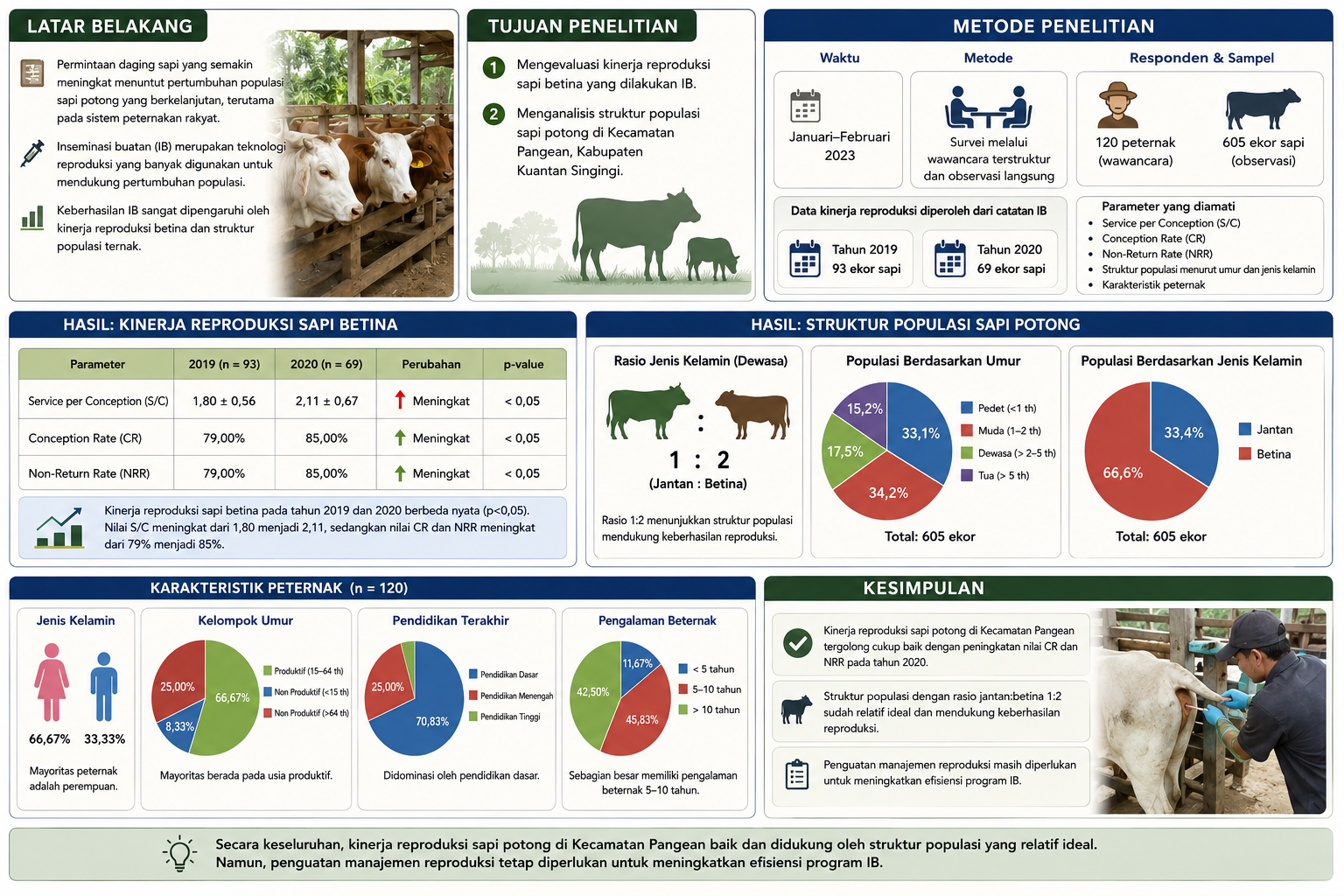
Sustainable growth of beef cattle production in tropical smallholder systems depends on the interaction between reproductive efficiency, herd structure, and farmer capacity. This study aimed to provide an integrated analysis of reproductive performance, herd structure, and farmer characteristics in a tropical smallholder beef cattle system. The research was conducted in the Pangean District, Kuantan Singingi Regency, Indonesia, using a survey approach involving 120 farmers and direct observation of 605 cattle. Reproductive performance data were obtained from artificial insemination records of 93 cows in 2019 and 69 cows in 2020. Key indicators included service per conception (S/C), conception rate (CR), and non-return rate (NRR), while population structure was analyzed based on age and sex composition, and farmer characteristics included age, education, and farming experience. The results showed that The reproductive indicators showed different responses between 2019 and 2020. Service per conception (S/C) decreased significantly (p<0.05), indicating improved breeding efficiency. Conception rate (CR) increased from 79% to 85%, but the difference was not statistically significant (p>0.05), suggesting stable fertilization capacity. In contrast, non-return rate (NRR) increased significantly from 79% to 85% (p<0.05), indicating improved post-insemination outcomes. Adult females dominated the herd structure, with a male-to-female ratio of 1:2, indicating strong reproductive potential. However, the generally low formal education level of farmers was associated with limitations in reproductive management practices.In conclusion, reproductive performance in tropical smallholder systems is shaped by the interaction between biological factors, population structure, and farmer capacity. Improving reproductive efficiency requires strengthening farmer knowledge, especially estrus detection and decision-making at the farm level.
Downloads
References
Allan FK, MacVicar IS, Peters AR and Schnier C. 2024. Systematic map of recent evidence on reproductive performance of cattle in Africa. Tropical Animal Health and Production. 56(7): 1–13. https://doi.org/10.1007/s11250-024-04074-z.
BPS. 2022. Populasi Sapi Menurut Provinsi (Ekor). Available at: https://www.bps.go.id/indicator/24/471/1/populasi-Sapi-menurut-kabupaten.html.
Diskin MG and Kenny DA. 2014. Optimising reproductive performance of beef cows and replacement heifers. Animal. 8: 27–39. https://doi.org/10.1017/S175173111400086X.
Febrianthoro F, Hartono M and Suharyati S. 2015. Faktor-faktor yang memengaruhi conception rate pada sapi bali di Kabupaten Pringsewu. Jurnal Ilmiah Peternakan Terpadu. 3(4): 239–244.
Gordon I. 2017. Reproductive Technologies In Farm Animals. CABI International
Hamzah MNA, Opi NAK and Esti RN. 2021. Evaluasi reproduksi induk sapi potong limosin dengan sistem perkawinan inseminasi buatan (studi lapang di Kelurahan Klampok Kecamatan Sananwetan Kota Blitar. AVES: Jurnal Ilmu Peternakan. 14(1): 11–20. https://doi.org/10.35457/aves.v14i1.1488.
Li Y, Mayberry D, Jemberu W, Schrobback P, Herrero M, Chaters G, Knight-Jones T and Rushton J. 2023. Characterizing ethiopian cattle production systems for disease burden analysis. Frontiers in Veterinary Science. 10: 1–9. https://doi.org/10.3389/fvets.2023.1233474.
LukmanHy L, Yuliani E, Zaenuri LA, Sumadiasa IWL, Mardiansyah M and Putra RA. 2023. Artificial insemination in local beef cattle breeding using various breeds of males in west Lombok Regency: an evaluation of its success rate. Jurnal Triton. 14(2): 483–491. https://doi.org/10.47687/jt.v14i2.501.
Molefe K and Mulunda M. 2023. Minerals, serum metabolites, hormones, and bovine reproduction: A review. Animal Health Research Reviews. 24(2): 54–63. https://doi.org/10.1017/S146625232400001X.
Moorey SE and Biase FH. 2020. Beef heifer fertility : importance of management practices and technological advancements. Journal of Animal Science and Biotechnology. 11: 1-12.
Nengsi SW. 2025. Integration of farming-livestock systems in sustainable agrocomplex development in Indonesia. Journal of Agro Complex Development Society. 2: 11–18.
Nkadimeng M, Marle-köster E V, Nengovhela NB, Ramukhithi F V, Mphaphathi ML, Rust JM and Makgahlela ML. 2022. Assessing reproductive performance to establish benchmarks for small-holder beef cattle herds in South Africa. Animal. 12: 3003. https://doi.org/https://doi.org/10.3390/ ani12213003.
Nor NM, Steeneveld W, Mourits MCM and Hogeveen H. 2015. The optimal number of heifer calves to be reared as dairy replacements. Journal of Dairy Science. 98(2): 861–871. https://doi.org/10.3168/jds.2014-8329.
Nur AS, Purwanto BP, Atabany A and Nurlaha N. 2018. Evaluasi aspek teknis pemeliharaan sapi perah berdasarkan Good Dairy Farming Practices (GDFP) di Peternakan Rakyat Cibungbulang. Jurnal Ilmu dan Teknologi Peternakan Tropis. 5(2): 79. https://doi.org/10.33772/jitro.v5i3.4977.
Purwantiningsih TI, Binsasi R and Araujo OC. 2022. Pengaruh modifikasi lingkungan terhadap status fisiologis sapi perah di lahan kering. Livestock and Animal Research. 20(1): 11. https://doi.org/10.20961/lar.v20i1.55158.
Rizki B, Yendraliza Y and Irawati E. 2023. Penerapan aspek teknis pemeliharaan ternak kerbau lumpur di Kecamatan Pangean Kabupaten Kuantan Singingi. Journal of Tropical Animal Science and Technology. 5(1): 25–33.
Saifullah R, Ismail M, Rusiyantono Y, Teguh M, Riandhana TE and Perdana S. 2024. Reproductive efficiency of Donggala Cattle in Donggala Regency. Jurnal Ilmiah Agrisains. 25(1): 21–27.
Saputra Y, Priyanto R, Putra BW and Cyrilla L. 2025. Strategy for development of cattle breeding and reproductive businesses in the cikedung people ’ s livestock area. Jurnal Ilmu Produksi dan Teknologi Hasil Peternakan. 13(105): 34–41. https://doi.org/https://doi.org/10.29244/jipthp.13.1.34-41.
Setiawanti TSW, Susilorini TE, Wahjuningsih S, Kuswati K and Suyadi S. 2025. Reproductive performance of indonesian friesian holstein dairy cattle across lactation periods: a case study at TIU-LBF Batu, Indonesia. Advances in Animal and Veterinary Sciences. 13(8): 1708–1715.
Silva WC da, Silva JAR da, Camargo-júnior RNC, Silva ÉBR, Santos MRP dos, Viana RB, Silva CMG da and Lourenco-Junior JB. 2023. Animal welfare and e ects of per-female stress on male and cattle reproduction — A review. Frontiers in Veterinary Science. 10(2): 1083469.
Talib C. 2002. Sapi bali di daerah sumber bibit dan peluang pengembangannya. Wartazoa. 12(3): 100–107.
Yendraliza. 2005. Performans reproduksi sapi pesisir dan sapi bali . di daerah inseminasi buatan kecamatan bayang kabupaten pesisir selatan. Jurnal Ilmu Peternakan. 2(1): 1–10.
Yendraliza Y, Elviriadi E, Febriyanti R and Irawati E. 2021. Penampilan reproduksi dan evaluasi inseminasi buatan sapi potong di Kecamatan Kelayang Indragiri Hulu. in Prosiding Seminar Nasional Teknologi Peternakan dan Veteriner. 87–97.
Yendraliza Y, Magfirah M, Rodiallah M, Islam U, Syarif S and Riau K. 2018. Struktur populasi dan potensi Kecamatan Benai Di Kabupaten Kuantan Singingi untuk pengembangan sapi potong. Jurnal Ilmiah Ilmu-Ilmu Peternakan. 21(2): 70–77.
Yendraliza Y, Rodiallah M, Astuti T and Elfawati E. 2020. Reproduction status and population dynamic of kuantan cattle in the kuantan singingi regency. Jurnal Ilmu Ternak dan Veteriner. 25(4): 162. https://doi.org/10.14334/jitv.v25i4.2541.
Downloads
Published
How to Cite
Issue
Section
License
Copyright (c) 2026 Yendraliza, Rafida, Rido Setiawan

This work is licensed under a Creative Commons Attribution-NonCommercial-ShareAlike 4.0 International License.
License and Copyright Agreement
In submitting the manuscript to the journal, the authors certify that:
- They are authorized by their co-authors to enter into these arrangements.
- The work described has not been formally published before, except in the form of an abstract or as part of a published lecture, review, thesis, or overlay journal. Please also carefully read Jurnal Ilmu Peternakan dan Veteriner Tropis (Journal of Tropical Animal and Veterinary Science) Posting Your Article Policy at https://journal.fapetunipa.ac.id/index.php/JIPVET/publicationethics
- That it is not under consideration for publication elsewhere,
- The publication has been approved by all authors and by the responsible authorities, tacitly or explicitly, of the institutions where the work was carried out.
- They secure the right to reproduce any material that has already been published or copyrighted elsewhere.
- They agree to the following license and copyright agreement.
Copyright
Authors who publish with Jurnal Ilmu Peternakan dan Veteriner Tropis (Journal of Tropical Animal and Veterinary Science) agree to the following terms:
- Authors retain copyright and grant the journal right of first publication with the work simultaneously licensed under a Creative Commons Attribution License (CC BY-NC-SA 4.0) that allows others to share the work with an acknowledgment of the work's authorship and initial publication in this journal.
- Authors are able to enter into separate, additional contractual arrangements for the non-exclusive distribution of the journal's published version of the work (e.g., post it to an institutional repository or publish it in a book), with an acknowledgment of its initial publication in this journal.
- Authors are permitted and encouraged to post their work online (e.g., in institutional repositories or on their website) prior to and during the submission process, as it can lead to productive exchanges, as well as earlier and greater citation of published work.

This work is licensed under a Creative Commons Attribution-NonCommercial-ShareAlike 4.0 International License.















.png)
