The effect of aloe vera extract in vivo on spermatozoa quality of sprague dawley rats
DOI:
https://doi.org/10.46549/jipvet.v16i2.596Keywords:
Aloe vera, density, motility, sperm, viabilityAbstract
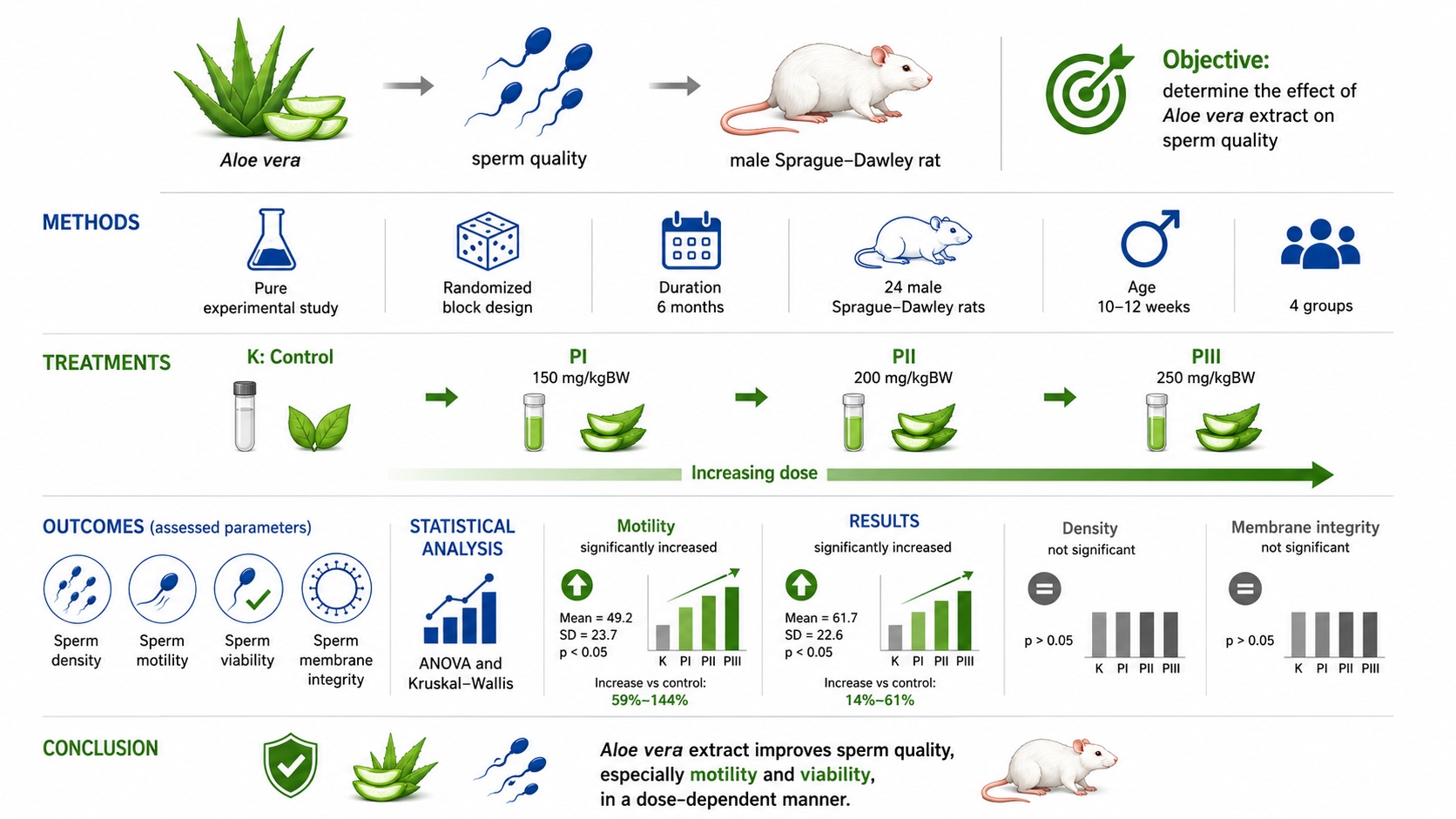
Aloe vera can act as an anti-fertility agent or increase fertility depending on dose, preparation and gender. Several studies have been carried out using a variety of doses in vitro and in vivo in both humans and animals experimental regarding the effect of Aloe vera on the quality of spermatozoa. Currently research on Aloe vera's effects on the reproductive system, particularly sperm quality, is still limited.This study aims to determine the effect of Aloe vera extract on the sperm quality of Sprague Dawley rats. This research is pure experimental with a randomized block design, for 6 months Population and research subjects are male white rats Sprague-Dawley strain, aged 10 – 12 weeks. The sample in this study was part of the population that met the inclusion and exclusion criteria, as many as 24 individuals and divided into 4 groups, namely the control group (K) and 3 treatment groups with Aloe vera extract (PI, a dose of 150 mg/kgBW; PII, a dose of 200 mg/kgBW, and PIII, a dose of 250 mg/kgBW) as the independent variable. The dependent variables were the quality parameters of spermatozoa, specifically including sperm density, sperm motility, sperm viability determined and sperm membrane integrity. The data was statistically processed using the ANOVA Test and Kruskal Wallis. The results showed that the administration of Aloe vera extract significantly increased spermatozoa motility (Mean=49.2; SD=23.7; p<0.05) and viability (Mean=61.7, SD=22.6; p < 0.05) in a dose-dependent manner. The overall increase in motility ranged from 59% to 144%, while viability improved by 14% to 61% across treatment groups compared to controls. The increase in density and integrity of spermatozoa membranes was not significant (p > 0.05). It was concluded that Aloe vera extract could improve the sperm quality of Sprague Dawley rats.
Downloads
References
Barbosa B de S, Santos FA dos, Macêdo LB do, Izzo RG, Fernandes DP, Praxedes ÉA and Silva AR. 2020. Effect of supplementation of Aloe vera extracts in cold storage media and cryopreservation of domestic cat epididymal spermatozoa. Anim. Reprod. 17(1). https://doi.org/10.21451/1984-3143-AR2019-0067
Bisen P, Karim F, Dhurvey V 2024. Impact Of Aloe vera consumption on Repeoductive system : A Review. J of Xi,an Univ of Architecture & Technology XVI (1) : 574 - 580
Dandekar SP, Nadkarni GD, Kulkarni VS and Punekar S. 2002. Lipid peroxidation and antioxidant enzymes in male infertility. J. Postgrad. Med. 48(3): 186–89; discussion 189-90
Estakhr J and Javdan N. 2011. Spermatogenic activity of aloe vera in adult male rats. Pharmacologyonline. 2: 886–889.
Fakhrildin MBM and Sodani IJ. 2014. Effect of Aloe vera extracts on in vitro human sperm parameters for asthenozoospermic patients. J. Thi-Qar Sci. 5(1): 8–13.
Farhangdoost F, Jafari Barmak M, Hemayatkhah Jahromi V, Azizi A, Mahmoodi R, Keshavarzi E and Naraki M. 2014. Aloe vera extract effect on sperm quality and testicular tissue of rats induced by cadmium chloride. Armaghane Danesh Bimonthly Journal. 19(1): 47–55.
Hossain M, MamunOrRashid A, Towfique N and Sen M. 2013. A review on ethnopharmacological potential of Aloe vera L. J. Intercult. Ethnopharmacol. 2(2): 113. https://doi.org/10.5455/jice.20130612035300
Hosseinzadeh Colagar A, Karimi F and Jorsaraei SGA. 2013. Correlation of sperm parameters with semen lipid peroxidation and total antioxidants Levels in Astheno- and Oligoasheno- Teratospermic men. Iran Red. Crescent. Med. J. 15(9). https://doi.org/10.5812/ircmj.6409
Jiwantare U. and Dhurvey V. 2022. Effect of Aloe vera and chloroquine on testes, sperm morphology and serum levels of reproductive hormones in albino rat. AGPE The Royal Gondwana Research Journal of History, Science, Economic, Political and Social science.03: 22-31.
Khojasteh SMB, Khamneh RJ, Houresfand M and Yaldagard E. 2016. A review on medicinal plants used for improvement of spermatogenesis. Biology and Medicine. 8(4): 1–7.
Majd NE, Tabandeh MR, Hosseinifar S and Sadeghi M. 2021. Protective effect of aloe vera gel against cisplatin-induced testicular damage, sperm alteration and oxidative stress in rats. Int. J. Fertil. Steril. 15(3): 210–218.
Modaresi M and Khodadadi A. 2014. The Effects of Aloe vera Extract on Reproductive Parameters in Mice. International Conference on Biological, Environment and Food Engineering (BEFE-2014) August 4-5, 2014 Bali (Indonesia). International Institute of Chemical, Biological & Environmental Engineering. https://doi.org/10.15242/IICBE.C814052
Nandal U and Bhardwaj RL. 2012. Aloe vera: A valuable wonder plant for food, medicine and cosmetic use - a review. Int. J. Pharm. Sci. Rev. Res. 13(1): 59–67.
Pour MM. 2019. In Vitro Spermaticidal Effect of Hydroalcoholic Crude Aloe Vera Leaf Extract on Animal Sperm Motility. International Conference on Biomedical Science (ICBM19). Istanbul.
Purwaningsih E, Mustofa S, Kuslestari K 2024. Diameter tubulus seminiferous dan Tebal epitel seminiferous tikus Jantan Galur Spraque Dawley setelah pemberian ekstrak Aloe vera. Majalah Saintikes 11 (1): 045 - 052
Salehi B, Albayrak S, Antolak H, Kręgiel D, Pawlikowska E, Sharifi-Rad M, Uprety Y, et al. 2018. Aloe genus plants: From farm to food applications and phytopharmacotherapy. Int. J. Mol. Sci. 19(9): 2843. https://doi.org/10.3390/ijms19092843
Shahroki A, Mojahed AS and Afshar-Goli J. 2014. The effects of hydroalcoholic extract of Aloe vera gel on spermatogenesis of adult male rats. International Journal of Biosciences (IJB). 5(7): 158–165. https://doi.org/10.12692/ijb/5.7.158-165
Singh P, Agarwal S, Singh H, Verma PK, Pandey AK and Kumar S. 2020. Antioxidant effects of Aloe vera as semen additive in cryopreservation of cattle bull semen. Int. J. Curr. Microbiol. Appl. Sci. 9(9): 1625–1635. https://doi.org/10.20546/ijcmas.2020.909.202
Surjushe A, Vasani R and Saple D. 2008. Aloe vera: A short review. Indian J. Dermatol. 53(4): 163. https://doi.org/10.4103/0019-5154.44785
Wu J, Zhang Y, Lv Z, Yu P and Shi W. 2021. Safety evaluation of Aloe vera soft capsule in acute, subacute toxicity and genotoxicity study. PLoS One. 16(3): e0249356. https//doi.org/10.1371/journal.pone.0249356
Yang HS, Han DK, Kim JR and Sim JC. 2006. Effects of α-Tocopherol on Cadmium-induced toxicity in rat testis and spermatogenesis. J. Korean Med. Sci. 21(3): 445. https://doi.org/10.3346/jkms.2006.21.3.445
Zohreh N, Shahla R and Reza M. 2014. The effect of aloe vera extract on the sperm quality in male diabetic rats. Bulletin of Environment, Pharmacology and Life Sciences. 3(3): 223–228.
Downloads
Published
How to Cite
Issue
Section
License
Copyright (c) 2026 Endang Purwaningsih, Samsul Mustofa, Marisa Riliani

This work is licensed under a Creative Commons Attribution-NonCommercial-ShareAlike 4.0 International License.
License and Copyright Agreement
In submitting the manuscript to the journal, the authors certify that:
- They are authorized by their co-authors to enter into these arrangements.
- The work described has not been formally published before, except in the form of an abstract or as part of a published lecture, review, thesis, or overlay journal. Please also carefully read Jurnal Ilmu Peternakan dan Veteriner Tropis (Journal of Tropical Animal and Veterinary Science) Posting Your Article Policy at https://journal.fapetunipa.ac.id/index.php/JIPVET/publicationethics
- That it is not under consideration for publication elsewhere,
- The publication has been approved by all authors and by the responsible authorities, tacitly or explicitly, of the institutions where the work was carried out.
- They secure the right to reproduce any material that has already been published or copyrighted elsewhere.
- They agree to the following license and copyright agreement.
Copyright
Authors who publish with Jurnal Ilmu Peternakan dan Veteriner Tropis (Journal of Tropical Animal and Veterinary Science) agree to the following terms:
- Authors retain copyright and grant the journal right of first publication with the work simultaneously licensed under a Creative Commons Attribution License (CC BY-NC-SA 4.0) that allows others to share the work with an acknowledgment of the work's authorship and initial publication in this journal.
- Authors are able to enter into separate, additional contractual arrangements for the non-exclusive distribution of the journal's published version of the work (e.g., post it to an institutional repository or publish it in a book), with an acknowledgment of its initial publication in this journal.
- Authors are permitted and encouraged to post their work online (e.g., in institutional repositories or on their website) prior to and during the submission process, as it can lead to productive exchanges, as well as earlier and greater citation of published work.

This work is licensed under a Creative Commons Attribution-NonCommercial-ShareAlike 4.0 International License.











.png)
