The effect of level substitution of tapioca flour with local indonesian tuber flour on the physicochemical quality of local chicken sausage
DOI:
https://doi.org/10.46549/jipvet.v15i3.591Keywords:
Chicken sausage, Local Indonesian crops, Physicochemical properties, Tuber flour substitution, Water-holding capacityAbstract
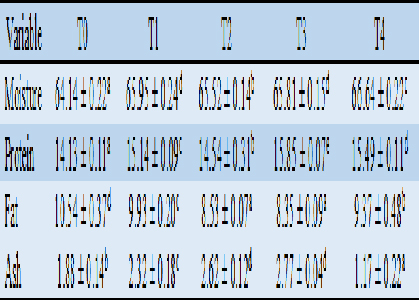
This study aimed to evaluate the effect of substituting tapioca flour with local Indonesian tuber flours on the physicochemical quality of chicken sausages. Three types of tuber flours—Cilembu sweet potato, purple sweet potato, and yellow sweet potato—were used as partial substitutes for tapioca flour. Four formulations were prepared: T0 (20 g tapioca, control), T1 (12 g tapioca + 2 g Cilembu + 2 g purple sweet potato + 4 g yellow sweet potato), T3 (12 g tapioca + 4 g Cilembu + 2 g purple sweet potato + 2 g yellow sweet potato), and T4 (12 g tapioca + 2 g Cilembu + 4 g purple sweet potato + 2 g yellow sweet potato). Physicochemical parameters assessed included pH, water-holding capacity (WHC), tenderness, cooking loss, and proximate composition (moisture, protein, fat, ash, and carbohydrate). The results showed that tuber flour substitution had a significant effect (P<0.05) on both chemical and physical qualities of chicken sausages. Treatment T3 exhibited the most favorable results, with higher protein and ash contents, lower fat levels, and improved WHC and tenderness compared to the control. These outcomes indicate that tuber flours not only act as effective functional fillers but also enhance the nutritional and technological qualities of chicken sausages. In conclusion, the partial substitution of tapioca with local Indonesian tuber flours offers a promising strategy to develop healthier and more functional meat products. This approach also supports the valorization of indigenous crops, contributing to food diversification and the utilization of local agricultural resources in Indonesia.
Downloads
References
AOAC. 2005. Official Methods of Analysis of AOAC International. Edisi ke-18. Assoc. Off. Anal. Chem., Arlington.
Delgado-Vargas F, Jimenez AR, Paredes OL. 2000. Natural pigments: carotenoids, anthocyanins, and betanns - characteristics, biosynthesis, processing, and stability. Critical Reviews in Food Science and Nutrition. 40(3); 173–289. https://doi.org/10.1080/10408690091189257
Gravelle AJ, Barbut S, Marangoni AG. 2017. Food-grade filler particles as an alternative method to modify the texture and stability of myofibrillar gels. Scientific Reports. https://doi.org/10.1038/s41598-017-11711-1
Hamm R. 1986. Functional properties of myofibrillar system and their measurement. Dalam: Bechtel PJ, editor. Muscle as Food. Academic Press. hlm. 135–199. https://doi.org/10.1016/B978-0-12-084190-5.50009-6
Heinz G, Hauzinger P. 2007. Meat Processing Technology for Small to Medium Scale Producers. Food and Agriculture Organization of The United Nations Regional Office for Asia and The Pacific, Bangkok. ISBN: 978-974-7946-99-4
Inriani N, Rumetor SD, Tethool AN. 2024. Analisis cemaran mikrobiologis pangan asal ternak pada jajanan anak sekolah dasar. Jurnal Ilmu Peternakan dan Veteriner Tropis. 14(2); 93–101. https://doi.org/10.46549/jipvet.v14i2.477
Ismanto A, Subaihah S. 2020. Sifat fisik, organoleptik dan aktivitas antioksidan sosis ayam dengan penambahan ekstrak daun sirsak (Annona muricata L.). Jurnal Ilmu Peternakan dan Veteriner Tropis. 10(1); 45–54. https://doi.org/10.46549/jipvet.v10i1.84
Jamhari, Rusman R, Erwanto Y. 2007. Pengaruh temperatur dan lama pemasakan terhadap kualitas fisik daging sapi. Buletin Peternakan. 2; 79–87. https://doi.org/10.21059/buletinpeternak.v30i2.1198
Saguy IS, Dana D. 2003. Integrated approach to deep fat frying: engineering, nutrition, health and consumer aspects. Journal of Food Engineering. 56; 143–152. https://doi.org/10.1016/S0260-8774(02)00243-1
Soeparno. 2015. Ilmu dan Teknologi Daging. Edisi kedua. Gadjah Mada University Press, Yogyakarta.
Swastike W, Suryanto E, Rusman R, Jamhari J, Hanim C, Erwanto Y, Jumari. 2020. The substitution effects of tapioca starch and beetroot powder as filler on the physical and sensory characteristics of chicken sausage. Jurnal Ilmu dan Teknologi Hasil Ternak. 15(2). https://doi.org/10.21776/ub.jitek.2020.015.02.5
Tanaka Y, Nobuhiro S, Monspart-Senyi J. 2016. Effect of drying methods for inner parameters of red beetroot (Beta vulgaris L.). Acta Universitatis Sapientiae, Alimentaria. 9; 60–68. https://doi.org/10.1515/ausal-2016-0006
Vaclavik VA, Christian EW. 2014. Food emulsions and foams. Dalam: Essentials of Food Science. Springer, New York. hlm. 263–276. https://doi.org/10.1007/978-1-4614-9138-5_13
Windyasmara L, Pertiwiningrum A, Erwanto Y, Asmoro NW, Afriyanti A. 2019. Kualitas fisik antimicrobial edible film (AmEF) dengan ekstrak daun teh (Camellia sinensis) dari gelatin limbah tulang ayam. Jurnal Ilmu Peternakan dan Veteriner Tropis. 9(1); 6–11. https://doi.org/10.30862/jipvet.v9i1.3
Downloads
Published
How to Cite
Issue
Section
License
Copyright (c) 2025 Muhammad Mar'ie Sirajuddin, Azchar P. P. Putra

This work is licensed under a Creative Commons Attribution-NonCommercial-ShareAlike 4.0 International License.
License and Copyright Agreement
In submitting the manuscript to the journal, the authors certify that:
- They are authorized by their co-authors to enter into these arrangements.
- The work described has not been formally published before, except in the form of an abstract or as part of a published lecture, review, thesis, or overlay journal. Please also carefully read Jurnal Ilmu Peternakan dan Veteriner Tropis (Journal of Tropical Animal and Veterinary Science) Posting Your Article Policy at https://journal.fapetunipa.ac.id/index.php/JIPVET/publicationethics
- That it is not under consideration for publication elsewhere,
- The publication has been approved by all authors and by the responsible authorities, tacitly or explicitly, of the institutions where the work was carried out.
- They secure the right to reproduce any material that has already been published or copyrighted elsewhere.
- They agree to the following license and copyright agreement.
Copyright
Authors who publish with Jurnal Ilmu Peternakan dan Veteriner Tropis (Journal of Tropical Animal and Veterinary Science) agree to the following terms:
- Authors retain copyright and grant the journal right of first publication with the work simultaneously licensed under a Creative Commons Attribution License (CC BY-NC-SA 4.0) that allows others to share the work with an acknowledgment of the work's authorship and initial publication in this journal.
- Authors are able to enter into separate, additional contractual arrangements for the non-exclusive distribution of the journal's published version of the work (e.g., post it to an institutional repository or publish it in a book), with an acknowledgment of its initial publication in this journal.
- Authors are permitted and encouraged to post their work online (e.g., in institutional repositories or on their website) prior to and during the submission process, as it can lead to productive exchanges, as well as earlier and greater citation of published work.

This work is licensed under a Creative Commons Attribution-NonCommercial-ShareAlike 4.0 International License.















.png)
