Feeding management practices and forage utilization in smallholder goat farming in Oransbari District, Papua Barat
DOI:
https://doi.org/10.46549/jipvet.v15i4.579Keywords:
Goat Feeding Management, Forage, Livestock Productivity, Smallholder Farmers, Papua Barat, Local Forage, Feeding TechnologyAbstract
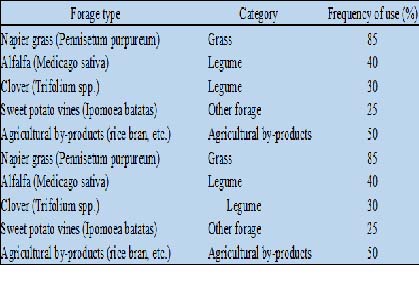
Smallholder goat production in remote regions of eastern Indonesia still relies mainly on traditional feeding practices that may limit animal performance. This study aimed to describe feed management and forage utilization by smallholder goat farmers in Oransbari District, South Manokwari Regency, West Papua, Indonesia. A descriptive case-study design was applied with 28 purposively selected farmers. Primary data were collected through field observations of available forage, semi-structured interviews on feeding practices, daily weighing of fresh forage offered by growth class, and laboratory analysis of representative forage samples for crude protein, crude fiber, and minerals. Most farmers were of productive age but had low to medium levels of formal education, and feeding decisions were driven mainly by experience and seasonal forage availability rather than by explicit nutritional planning. Adult goats typically received 2–4% of live weight as fresh forage per day, while kids and growers received approximately 1–6%, with rations dominated by Napier grass supplemented with legumes, sweet potato vines, and agricultural by-products. Forage analysis confirmed that the inclusion of legumes substantially increased dietary protein, whereas practices such as wilting and systematic forage conservation were rarely applied. These findings highlight the need for targeted training on nutrition-based rationing, forage conservation, and strategic use of crop residues to improve feed efficiency, animal health, and the sustainability of smallholder goat systems in Oransbari.
Downloads
Publication Integrity
WALABI applies editorial screening and peer review in accordance with its journal policies.
- Similarity screening reference: 20% (evaluated in context)
- Ethical approval disclosure is required where applicable
- Generative AI / AI-assisted technology disclosure is required where applicable
- Author contributions are expected
- Conflict of interest disclosure is expected
References
Agrawal N, Sharma D, Mandal A, Rout P, Kushwah Y. 2015. Dynamics of faecal egg count in natural infection of Haemonchus spp. in Indian goats. Veterinary World. 8(1); 38–41. https://doi.org/10.14202/vetworld.2015.38-41
Alemayehu G, Mamo G, Alemu B, Desta H, Wieland B. 2021. Towards objective measurement of reproductive performance of traditionally managed goat flocks in the drylands of Ethiopia. Tropical Animal Health and Production. 53(1). https://doi.org/10.1007/s11250-021-02556-y
Chebli Y, El Otmani S, Hornick JL, Keli A, Bindelle J, Cabaraux JF, Chentouf M. 2022. Forage availability and quality, and feeding behaviour of indigenous goats grazing in a Mediterranean silvopastoral system. Ruminants. 2(1); 74–89. https://doi.org/10.3390/ruminants2010004
Chand S, Ranga I, Singhal R, Govindasamy P. 2022. Agronomical and breeding approaches to improve the nutritional status of forage crops for better livestock productivity. Grass and Forage Science. 77(1); 11–32. https://doi.org/10.1111/gfs.12557
Cooke AS, Machekano H, Ventura-Cordero J, Louro-Lopez A, Joseph V, Gwiriri LC, Takahashi T, Morgan ER, Lee MRF, Nyamukondiwa C. 2024. Opportunities to improve goat production and food security in Botswana through forage nutrition and the use of supplemental feeds. Food Security. 16(3); 607–622. https://doi.org/10.1007/s12571-024-01452-1
Gillespie J, Qushim B, Nyaupane N, McMillin K. 2015. Breeding technologies in U.S. meat goat production: Who are the adopters and how does adoption impact productivity? Agricultural and Resource Economics Review. 44(3); 315–339. https://doi.org/10.1017/s1068280500005086
Gökdai A, Sakarya E, Contiero B, Gottardo F. 2020. Milking characteristics, hygiene and management practices in Saanen goat farms: A case of Canakkale province, Turkey. Italian Journal of Animal Science. 19(1); 213–221. https://doi.org/10.1080/1828051x.2020.1718006
Henry B, Eckard R, Beauchemin K. 2018. Review: Adaptation of ruminant livestock production systems to climate changes. Animal. 12; s445–s456. https://doi.org/10.1017/s1751731118001301
Huang J, Jiao S, Fu Y, Zhao W, Diao Q, Ma T, Zhang N. 2024. Effect of feeding level on growth and slaughter performance, and allometric growth of tissues and organs in female growing Saanen dairy goats. Animals. 14(5); 730. https://doi.org/10.3390/ani14050730
Leathwick D, Ganesh S, Waghorn T. 2015. Evidence for reversion towards anthelmintic susceptibility in Teladorsagia circumcincta in response to resistance management programmes. International Journal for Parasitology: Drugs and Drug Resistance. 5(1); 9–15. https://doi.org/10.1016/j.ijpddr.2015.01.001
MacLeod N, Waldron S, Wen S. 2015. A comprehensive approach for assessing the economic contribution of forage and livestock improvement options to smallholder farming enterprises. Journal of Integrative Agriculture. 14(8); 1573–1580. https://doi.org/10.1016/s2095-3119(15)61091-7
Ntuli L, Fourie P. 2021. Appraisal of the management practices of goat farmers in selected districts of the KwaZulu-Natal province: Can the extensionist play a role to improve? South African Journal of Agricultural Extension (Sajae). 49(2); 84–96. https://doi.org/10.17159/2413-3221/2021/v49n2a12805
Obinna L, Onu S. 2021. Use of improved production technologies among goat farmers in Abia State Nigeria. Journal of Agricultural Extension. 25(2); 96–106. https://doi.org/10.4314/jae.v25i2.9
Rangasami SR, Purnima M, Pushpam R, Ajaykumar R, Thirunavukkarasu M, Sathiya K, Rajanbabu V, Yazhini G. 2024. Enhancing animal nutritional security through biofortification in forage crops: A comprehensive review. Indian Journal of Animal Research. 58(11); 1838–1845. https://doi.org/10.18805/IJAR.B-5466
Sargison ND, Ivil SAJ, Abraham J, Abubaker SPS, Hopker AM, Mazeri S, Otter IA, Otter N. 2017. Investigation of productivity in a south Indian Malabari goat herd shows opportunities for planned animal health management to improve food security. Veterinary Record. 180; 278. https://doi.org/10.1136/vr.103801
Ribeiro DM, Guedes C, González Montaña JR, Pereira AF, Zaralis K, Geraldo A, Tzamaloukas O, Cabrera MG, Castro N, Argüello A, Hernández-Castellano LE, Alonso-Diez ÁJ, Martín MJ, Cal-Pereyra LG, Stilwell G, de Almeida AM. 2022. Extensive sheep and goat production: The role of novel technologies towards sustainability and animal welfare. Animals. 12(7); 885. https://doi.org/10.3390/ani12070885
Taruvinga A, Kambanje A, Mushunje A, Mukarumbwa P. 2022. Determinants of livestock species ownership at household level: Evidence from rural OR Tambo District Municipality, South Africa. Pastoralism: Research, Policy and Practice. 12(1). https://doi.org/10.1186/s13570-021-00220-6
Tyson F, Dalesman S, Brophy P, Morphew R. 2020. Novel equine faecal egg diagnostics: Validation of the FECPAKG2. Animals. 10(8); 1254. https://doi.org/10.3390/ani10081254
Downloads
Published
How to Cite
Issue
Section
License
Copyright (c) 2025 Ribka H. Sellau, Evi W Saragih, Marlyn N. Lekitoo

This work is licensed under a Creative Commons Attribution-NonCommercial-ShareAlike 4.0 International License.
License and Copyright Agreement
In submitting the manuscript to the journal, the authors certify that:
- They are authorized by their co-authors to enter into these arrangements.
- The work described has not been formally published before, except in the form of an abstract or as part of a published lecture, review, thesis, or overlay journal. Please also carefully read Jurnal Ilmu Peternakan dan Veteriner Tropis (Journal of Tropical Animal and Veterinary Science) Posting Your Article Policy at https://journal.fapetunipa.ac.id/index.php/JIPVET/publicationethics
- That it is not under consideration for publication elsewhere,
- The publication has been approved by all authors and by the responsible authorities, tacitly or explicitly, of the institutions where the work was carried out.
- They secure the right to reproduce any material that has already been published or copyrighted elsewhere.
- They agree to the following license and copyright agreement.
Copyright
Authors who publish with Jurnal Ilmu Peternakan dan Veteriner Tropis (Journal of Tropical Animal and Veterinary Science) agree to the following terms:
- Authors retain copyright and grant the journal right of first publication with the work simultaneously licensed under a Creative Commons Attribution License (CC BY-NC-SA 4.0) that allows others to share the work with an acknowledgment of the work's authorship and initial publication in this journal.
- Authors are able to enter into separate, additional contractual arrangements for the non-exclusive distribution of the journal's published version of the work (e.g., post it to an institutional repository or publish it in a book), with an acknowledgment of its initial publication in this journal.
- Authors are permitted and encouraged to post their work online (e.g., in institutional repositories or on their website) prior to and during the submission process, as it can lead to productive exchanges, as well as earlier and greater citation of published work.

This work is licensed under a Creative Commons Attribution-NonCommercial-ShareAlike 4.0 International License.















.png)
